


Page 209 - Handout Computer Network.
P. 209
Computer Network                                                             2026


            m. In symmetric key systems, Alice’s and Bob’s keys are identical and are secret. In public key
            systems, a pair of keys is used. One of the keys is known to both Bob and Alice (indeed, it is known
            to the whole world). The other key is known only by either Bob or Alice (but not both). In the
            following two subsections, we consider symmetric key and public key systems in more detail.
                 7.2.1 Symmetric Key Cryptography


            All cryptographic algorithms involve substituting one thing for another, for exam plea, taking a
            piece of plaintext and then computing and substituting the appropriate ciphertext to create the
            encrypted message.
            Before  studying  a  modern  key-based  cryptographic  system,  let  us  first  get  our  feet  wet  by
            studying a very old, very simple symmetric key algorithm attributed to Julius Caesar, known as
            the Caesar cipher (a cipher is a method for encrypting data).

            For English text, the Caesar cipher would work by taking each letter in the plain text message and
            substituting the letter that is k letters later (allowing wraparound; that is, having the letter z
            followed by the letter a) in the alphabet.

            For example, if k = 3, then the letter a in plaintext becomes d in ciphertext; b in plaintext becomes
            e in ciphertext, and so on. Here, the value of k serves as the key. As an example, the plaintext
            message “bob, i love you. Alice” becomes “ere, l oryh brx. dolfh” in ciphertext.

            While the ciphertext does indeed look like gibberish, it wouldn’t take long to break the code if
            you knew that the Caesar cipher was being used, as there are only 25 possible key values.
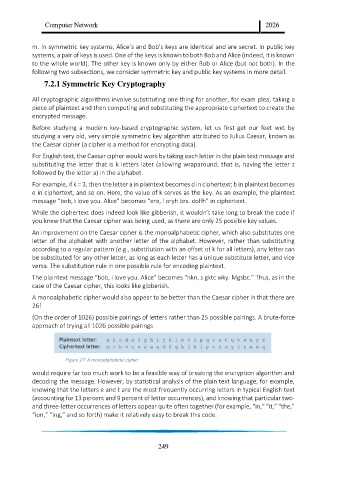
            An improvement on the Caesar cipher is the monoalphabetic cipher, which also substitutes one
            letter of the alphabet with another letter of the alphabet. However, rather than substituting
            according to a regular pattern (e.g., substitution with an offset of k for all letters), any letter can
            be substituted for any other letter, as long as each letter has a unique substitute letter, and vice
            versa. The substitution rule in one possible rule for encoding plaintext.
            The plaintext message “bob, i love you. Alice” becomes “nkn, s gktc wky. Mgsbc.” Thus, as in the
            case of the Caesar cipher, this looks like gibberish.
            A monoalphabetic cipher would also appear to be better than the Caesar cipher in that there are
            26!

            (On the order of 1026) possible pairings of letters rather than 25 possible pairings. A brute-force
            approach of trying all 1026 possible pairings


                        Figure 27: A monoalphabetic cipher

            would require far too much work to be a feasible way of breaking the encryption algorithm and
            decoding the message. However, by statistical analysis of the plain text language, for example,
            knowing that the letters e and t are the most frequently occurring letters in typical English text
            (accounting for 13 percent and 9 percent of letter occurrences), and knowing that particular two-
            and three-letter occurrences of letters appear quite often together (for example, “in,” “it,” “the,”
            “ion,” “ing,” and so forth) make it relatively easy to break this code.


                                                         249

