


Page 210 - Handout Computer Network.
P. 210
If the intruder has some knowledge about the possible contents of the message, then it is even
                 easier to break the code. For example, if Trudy the intruder is Bob’s wife and suspects Bob of
                 having an affair with Alice, then she might suspect that the names “bob” and “alice” appear in
                 the text.

                 If Trudy knew for certain that those two names appeared in the ciphertext and had a copy of the
                 example ciphertext message above, then she could immediately determine seven of the 26 letter
                 pairings, requiring 109 fewer possibilities to be checked by a brute-force method.

                 Indeed, if Trudy suspected Bob of having an affair, she might well expect to find some other
                 choice words in the message as well. When considering how easy it might be for Trudy to break
                 Bob and Alice’s encryption scheme, one can distinguish three different scenarios, depending on
                 what information the intruder has.

                 • Ciphertext-only attack. In some cases, the intruder may have access only to the intercepted
                 ciphertext, with no certain information about the contents of the plain text message. We have
                 seen how statistical analysis can help in a ciphertext-only attack on an encryption scheme.
                 • Known-plaintext attack. We saw above that if Trudy somehow knew for sure that “bob” and
                 “alice”  appeared  in  the ciphertext  message,  then  she could  have  determined  the  (plaintext,
                 ciphertext) pairings for the letters a, l, i, c, e, b, and o. Trudy might also have been fortunate
                 enough  to  have  recorded  all  of  the  cipher  text  transmissions  and  then  found  Bob’s  own
                 decrypted version of one of the transmissions scribbled on a piece of paper. When an intruder
                 knows some of the (plaintext, ciphertext) pairings, we refer to this as a known-plaintext attack
                 on the encryption scheme.

                 •  Chosen-plaintext  attack.  In  a  chosen-plaintext  attack,  the  intruder  is  able  to  choose  the
                 plaintext  message  and  obtain  its  corresponding  ciphertext  form.  For  the  simple  encryption
                 algorithms, we’ve seen so far, if Trudy could get Alice to send the message, “The quick brown fox
                 jumps over the lazy dog,” she could completely break the encryption scheme. We’ll see shortly
                 that  for  more  sophisticated  encryption  techniques,  a  chosen-plaintext  attack  does  not
                 necessarily  mean  that  the  encryption  technique  can  be  broken.  Five  hundred  years  ago,
                 techniques improving on monoalphabetic encryption, known as polyalphabetic encryption, were
                 invented. The idea behind polyalphabetic encryption is to use multiple monoalphabetic ciphers,
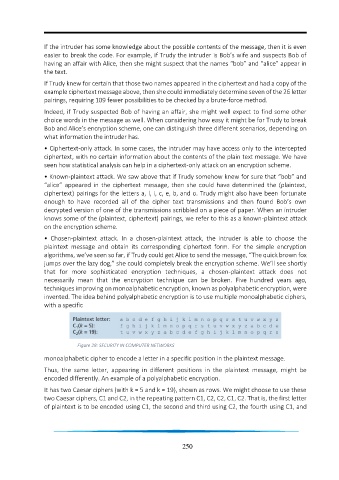
                 with a specific


                            Figure 28: SECURITY IN COMPUTER NETWORKS

                 monoalphabetic cipher to encode a letter in a specific position in the plaintext message.
                 Thus,  the  same  letter,  appearing  in  different  positions  in  the  plaintext  message,  might  be
                 encoded differently. An example of a polyalphabetic encryption.

                 It has two Caesar ciphers (with k = 5 and k = 19), shown as rows. We might choose to use these
                 two Caesar ciphers, C1 and C2, in the repeating pattern C1, C2, C2, C1, C2. That is, the first letter
                 of plaintext is to be encoded using C1, the second and third using C2, the fourth using C1, and


                                                                 250

