


Page 28 - Handout Computer Network.
P. 28
distances,  physical  connectors,  and  other  similar  attributes  are  defined  by  physical  layer
               specifications.

                      https://www.youtube.com/watch?v=8YkL_qc6ozc&t=7s


               2.8 Introduction to TCP/IP
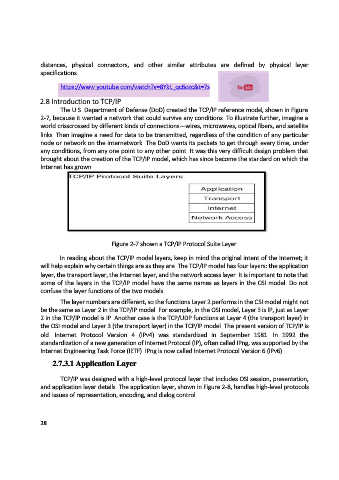
                      The U.S. Department of Defense (DoD) created the TCP/IP reference model, shown in Figure
               2-7, because it wanted a network that could survive any conditions. To illustrate further, imagine a
               world crisscrossed by different kinds of connections—wires, microwaves, optical fibers, and satellite
               links. Then imagine a need for data to be transmitted, regardless of the condition of any particular
               node or network on the internetwork. The DoD wants its packets to get through every time, under
               any conditions, from any one point to any other point. It was this very difficult design problem that
               brought about the creation of the TCP/IP model, which has since become the standard on which the
               Internet has grown.


                                         Figure 2-7 shown a TCP/IP Protocol Suite Layer

                      In reading about the TCP/IP model layers, keep in mind the original intent of the Internet; it
               will help explain why certain things are as they are. The TCP/IP model has four layers: the application
               layer, the transport layer, the Internet layer, and the network access layer. It is important to note that
               some of the layers in the TCP/IP model have the same names as layers in the OSI model. Do not
               confuse the layer functions of the two models.

                      The layer numbers are different, so the functions Layer 2 performs in the OSI model might not
               be the same as Layer 2 in the TCP/IP model. For example, in the OSI model, Layer 3 is IP, just as Layer
               2 in the TCP/IP model is IP. Another case is the TCP/UDP functions at Layer 4 (the transport layer) in
               the OSI model and Layer 3 (the transport layer) in the TCP/IP model. The present version of TCP/IP is
               old.  Internet  Protocol  Version  4  (IPv4)  was  standardized  in  September  1981.  In  1992  the
               standardization of a new generation of Internet Protocol (IP), often called IPng, was supported by the
               Internet Engineering Task Force (IETF). IPng is now called Internet Protocol Version 6 (IPv6).
                    2.7.3.1 Application Layer


                      TCP/IP was designed with a high-level protocol layer that includes OSI session, presentation,
               and application layer details. The application layer, shown in Figure 2-8, handles high-level protocols
               and issues of representation, encoding, and dialog control.


               28

