


Page 32 - Handout Computer Network.
P. 32
•  IP—Provides  connectionless,  best-effort  delivery  routing  of  packets.  It  is  not
                              concerned with the packets’ content. Instead, it looks for a way to move the packets
                              to their destination.

                          •  Internet  Control  Message  Protocol  (ICMP)—Provides  control  and  messaging
                              capabilities.
                          •  Address Resolution Protocol (ARP)—Determines the data link layer addresses (Media
                              Access Control [MAC] addresses) for known IP addresses.

                          •  Reverse Address Resolution Protocol (RARP)—Determines IP addresses when data link
                              layer addresses (MAC addresses) are known.

               IP performs the following operations:


                          •  Defining a packet and an addressing scheme

                          •  Transferring data between the Internet layer and the network access layer

                          •  Routing  packets  to  remote  hosts  Finally,  to  clarify  terminology,  IP  is  sometimes
                              referred to as an unreliable protocol. This does not mean that IP does not accurately
                              deliver data across a network; it simply means that IP does not perform error checking
                              and correction. That function is handled by upper-layer protocols from the transport
                              or application layer.

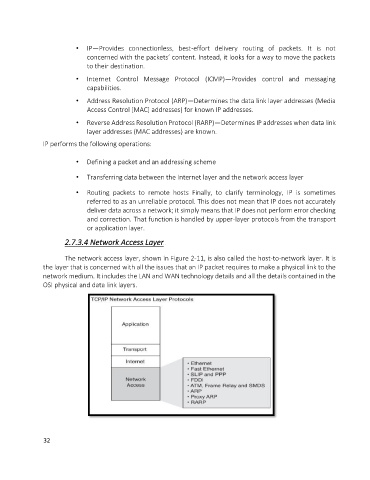
                      2.7.3.4 Network Access Layer


                      The network access layer, shown in Figure 2-11, is also called the host-to-network layer. It is
               the layer that is concerned with all the issues that an IP packet requires to make a physical link to the
               network medium. It includes the LAN and WAN technology details and all the details contained in the
               OSI physical and data link layers.


               32

