


Page 35 - Handout Computer Network.
P. 35
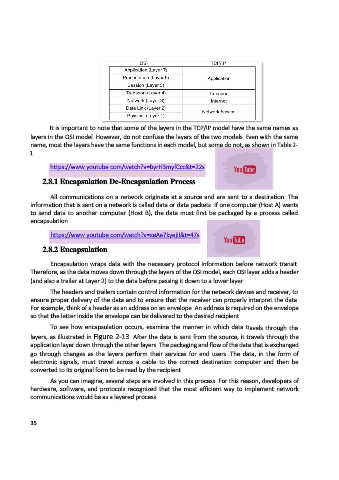
It is important to note that some of the layers in the TCP/IP model have the same names as
            layers in the OSI model. However, do not confuse the layers of the two models. Even with the same
            name, most the layers have the same functions in each model, but some do not, as shown in Table 2-
            1.

                   https://www.youtube.com/watch?v=byrH3myfCcc&t=22s

                2.8.1 Encapsulation De-Encapsulation Process


                   All communications on a network originate at a source and are sent to a destination. The
            information that is sent on a network is called data or data packets. If one computer (Host A) wants
            to send data to another computer (Host B), the data must first be packaged by a process called
            encapsulation.


                   https://www.youtube.com/watch?v=xeAe7kyejiI&t=47s

                2.8.2 Encapsulation

                   Encapsulation wraps data with the necessary protocol information before network transit.
            Therefore, as the data moves down through the layers of the OSI model, each OSI layer adds a header
            (and also a trailer at Layer 2) to the data before passing it down to a lower layer.
                   The headers and trailers contain control information for the network devices and receiver, to
            ensure proper delivery of the data and to ensure that the receiver can properly interpret the data.
            For example, think of a header as an address on an envelope. An address is required on the envelope
            so that the letter inside the envelope can be delivered to the desired recipient.
                   To see how encapsulation occurs, examine the manner in which data travels through the

            layers, as illustrated in Figure 2-13. After the data is sent from the source, it travels through the
            application layer down through the other layers. The packaging and flow of the data that is exchanged
            go  through changes  as  the  layers  perform  their services  for  end  users. The  data,  in  the  form  of
            electronic  signals,  must  travel  across  a  cable  to  the  correct  destination  computer  and  then  be
            converted to its original form to be read by the recipient.
                   As you can imagine, several steps are involved in this process. For this reason, developers of
            hardware, software, and protocols recognized that the most efficient way to implement network
            communications would be as a layered process.


            35

