


Page 37 - Handout Computer Network.
P. 37
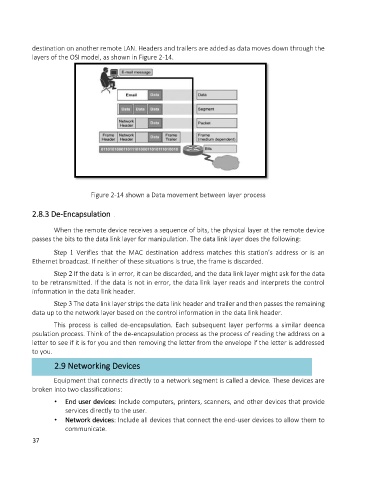
destination on another remote LAN. Headers and trailers are added as data moves down through the
            layers of the OSI model, as shown in Figure 2-14.


                               Figure 2-14 shown a Data movement between layer process


            2.8.3 De-Encapsulation

                   When the remote device receives a sequence of bits, the physical layer at the remote device
            passes the bits to the data link layer for manipulation. The data link layer does the following:
                   Step  1  Verifies  that  the  MAC  destination  address  matches  this  station’s  address  or  is  an
            Ethernet broadcast. If neither of these situations is true, the frame is discarded.

                   Step 2 If the data is in error, it can be discarded, and the data link layer might ask for the data
            to be retransmitted. If the data is not in error, the data link layer reads and interprets the control
            information in the data link header.
                   Step 3 The data link layer strips the data link header and trailer and then passes the remaining
            data up to the network layer based on the control information in the data link header.
                   This  process  is  called  de-encapsulation.  Each  subsequent  layer  performs  a  similar  deenca
            psulation process. Think of the de-encapsulation process as the process of reading the address on a
            letter to see if it is for you and then removing the letter from the envelope if the letter is addressed
            to you.
                   2.9 Networking Devices


                   Equipment that connects directly to a network segment is called a device. These devices are
            broken into two classifications:
                   •  End user devices: Include computers, printers, scanners, and other devices that provide
                       services directly to the user.
                   •  Network devices: Include all devices that connect the end-user devices to allow them to
                       communicate.
            37

