


Page 38 - Handout Computer Network.
P. 38
2.9.1 End-user devices that provide users with a connection to the network
                    are also called hosts.


                      These devices allow users to share, create, and obtain information. Host devices can exist
               without a network, but without a network, host capabilities are greatly reduced. Host devices are
               physically  connected  to  the  network  media  using  a  network  interface  card  (NIC).  They  use  this
               connection to perform the tasks of sending e-mails, printing reports, scanning pictures, or accessing
               databases. A NIC is a printed circuit board that fits into the expansion slot of a bus on a computer
               motherboard, or it can be a peripheral device. It is also called a network adapter. Laptop or notebook
               computer NICs are usually the size of a PCMCIA card.
                      Each NIC carries a unique code called a MAC address. MAC addresses are covered more in a
               moment. As the name implies, the NIC controls host access to the medium. There are no standardized
               symbols for end-user devices in the networking industry. They bear a resemblance to the real device
               to allow for quick recognition.


               2.9.1.1 Network Interface Cards

                      Network interface cards (NICs) are considered Layer 2 devices because each NIC throughout
               the world carries a unique code, called a Media Access Control (MAC) address. This address controls
               data communication for the host on the LAN. The NIC controls the access of the host to the medium.
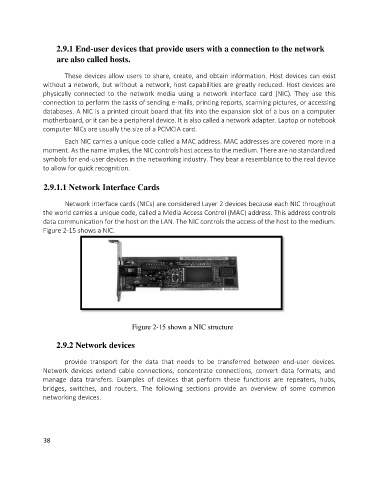
               Figure 2-15 shows a NIC.


                                             Figure  2 - 15  shown a NIC structure
                    2.9.2 Network devices


                      provide  transport  for  the  data  that  needs  to  be  transferred  between  end-user  devices.
               Network  devices  extend  cable  connections,  concentrate  connections,  convert  data  formats,  and
               manage  data  transfers.  Examples  of  devices  that  perform  these  functions  are  repeaters,  hubs,
               bridges,  switches,  and  routers.  The  following  sections  provide  an  overview  of  some  common
               networking devices.


               38

