


Page 71 - Handout Computer Network.
P. 71
3.7.5 Simplex, Half-Duplex, and Full-Duplex Operation


                      The data channels over which a signal is sent can operate in one of three ways: simplex,
               half duplex, or full duplex. The distinction among these is in the way the signal can travel.
               Simplex transmission, as its name implies, is simple. It is also called unidirectional because the
               signal travels in only one direction, just like traffic flows on a one-way street.

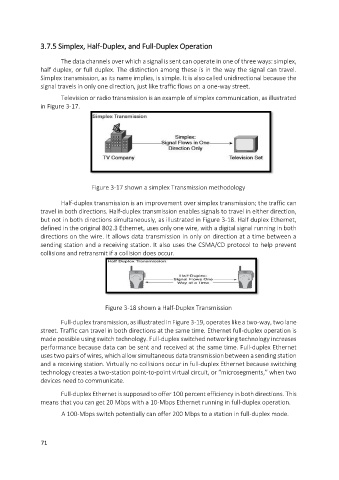
                      Television or radio transmission is an example of simplex communication, as illustrated
               in Figure 3-17.


                                 Figure 3-17 shown a simplex Transmission methodology


                      Half-duplex transmission is an improvement over simplex transmission; the traffic can
               travel in both directions. Half-duplex transmission enables signals to travel in either direction,
               but not in both directions simultaneously, as illustrated in Figure 3-18. Half duplex Ethernet,
               defined in the original 802.3 Ethernet, uses only one wire, with a digital signal running in both
               directions on the wire. It allows data transmission in only on direction at a time between a
               sending station and a receiving station. It also uses the CSMA/CD protocol to help prevent
               collisions and retransmit if a collision does occur.


                                      Figure 3-18 shown a Half-Duplex Transmission

                      Full-duplex transmission, as illustrated in Figure 3-19, operates like a two-way, two lane
               street. Traffic can travel in both directions at the same time. Ethernet full-duplex operation is
               made possible using switch technology. Full-duplex switched networking technology increases
               performance because data can be sent and received at the same time. Full-duplex Ethernet
               uses two pairs of wires, which allow simultaneous data transmission between a sending station
               and a receiving station. Virtually no collisions occur in full-duplex Ethernet because switching
               technology creates a two-station point-to-point virtual circuit, or “microsegments,” when two
               devices need to communicate.

                      Full-duplex Ethernet is supposed to offer 100 percent efficiency in both directions. This
               means that you can get 20 Mbps with a 10-Mbps Ethernet running in full-duplex operation.
                       A 100-Mbps switch potentially can offer 200 Mbps to a station in full-duplex mode.


               71

