


Page 74 - Handout Computer Network.
P. 74
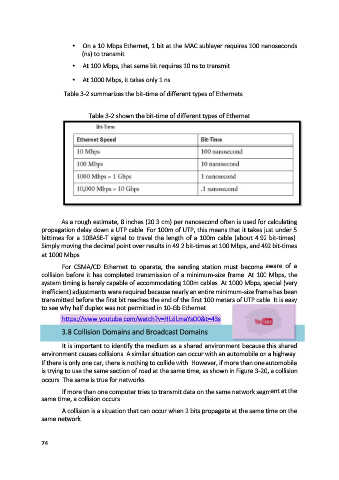
•  On a 10 Mbps Ethernet, 1 bit at the MAC sublayer requires 100 nanoseconds
                              (ns) to transmit.

                          •  At 100 Mbps, that same bit requires 10 ns to transmit.

                          •  At 1000 Mbps, it takes only 1 ns.

                        Table 3-2 summarizes the bit-time of different types of Ethernets.


                                Table 3-2 shown the bit-time of different types of Ethernet


                      As a rough estimate, 8 inches (20.3 cm) per nanosecond often is used for calculating
               propagation delay down a UTP cable. For 100m of UTP, this means that it takes just under 5
               bittimes for a 10BASE-T signal to travel the length of a 100m cable (about 4.92 bit-times).
               Simply moving the decimal point over results in 49.2 bit-times at 100 Mbps, and 492 bit-times
               at 1000 Mbps.

                      For  CSMA/CD  Ethernet  to  operate,  the  sending  station  must  become  aware  of  a
               collision before it has completed transmission of a minimum-size frame. At 100 Mbps, the
               system timing is barely capable of accommodating 100m cables. At 1000 Mbps, special (very
               inefficient) adjustments were required because nearly an entire minimum-size frame has been
               transmitted before the first bit reaches the end of the first 100 meters of UTP cable. It is easy
               to see why half duplex was not permitted in 10-Gb Ethernet.
                      https://www.youtube.com/watch?v=HLziLmaYsO0&t=43s

                       3.8 Collision Domains and Broadcast Domains

                      It is important to identify the medium as a shared environment because this shared
               environment causes collisions. A similar situation can occur with an automobile on a highway.
               If there is only one car, there is nothing to collide with. However, if more than one automobile
               is trying to use the same section of road at the same time, as shown in Figure 3-20, a collision
               occurs. The same is true for networks.

                      If more than one computer tries to transmit data on the same network segment at the
               same time, a collision occurs.
                      A collision is a situation that can occur when 2 bits propagate at the same time on the
               same network.


               74

