


Page 75 - Handout Computer Network.
P. 75
A small, slow network could work out a system that allows only two computers to send
               messages, with both agreeing to take turns.

                      The problem is that many computers are connected to large networks, with each one
               wanting to communicate millions of bits every section.


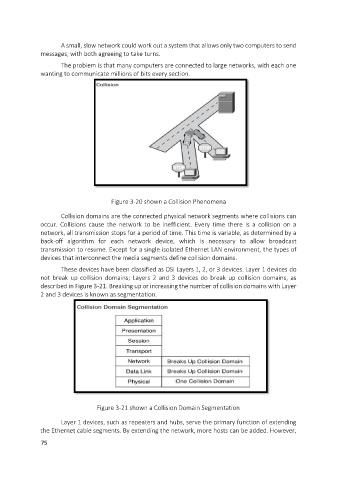
                                        Figure 3-20 shown a Collision Phenomena

                      Collision domains are the connected physical network segments where collisions can
               occur.  Collisions  cause  the  network  to  be  inefficient.  Every  time  there  is  a  collision  on  a
               network, all transmission stops for a period of time. This time is variable, as determined by a
               back-off  algorithm  for  each  network  device,  which  is  necessary  to  allow  broadcast
               transmission to resume. Except for a single isolated Ethernet LAN environment, the types of
               devices that interconnect the media segments define collision domains.
                      These devices have been classified as OSI Layers 1, 2, or 3 devices. Layer 1 devices do
               not  break  up  collision  domains;  Layers  2  and  3 devices  do  break  up collision  domains,  as
               described in Figure 3-21. Breaking up or increasing the number of collision domains with Layer
               2 and 3 devices is known as segmentation.


                                   Figure 3-21 shown a Collision Domain Segmentation

                      Layer 1 devices, such as repeaters and hubs, serve the primary function of extending
               the Ethernet cable segments. By extending the network, more hosts can be added. However,
               75

