


Page 19 - Future Stars Science Explorer-5
P. 19
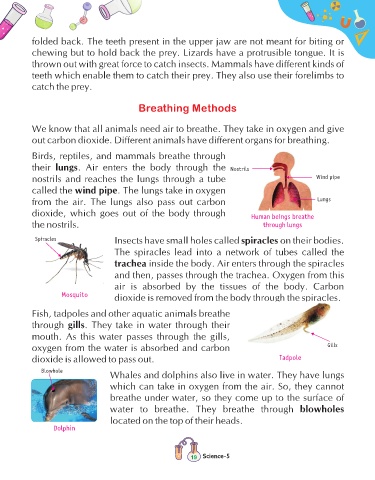
folded back. The teeth present in the upper jaw are not meant for biting or
            chewing but to hold back the prey. Lizards have a protrusible tongue. It is
            thrown out with great force to catch insects. Mammals have different kinds of

            teeth which enable them to catch their prey. They also use their forelimbs to
            catch the prey.


                                                 Breathing Methods


            We know that all animals need air to breathe. They take in oxygen and give

            out carbon dioxide. Different animals have different organs for breathing.

            Birds, reptiles, and mammals breathe through


            their  lungs.  Air  enters  the  body  through  the  Nostrils
            nostrils and reaches the lungs through a tube                                                     Wind pipe

            called the wind pipe. The lungs take in oxygen
            from the air. The lungs also pass out carbon                                                       Lungs

            dioxide, which goes out of the body through                                 Human beings breathe
            the nostrils.                                                                   through lungs


              Spiracles                  Insects have small holes called spiracles on their bodies.
                                         The spiracles lead into a network of tubes called the

                                         trachea inside the body. Air enters through the spiracles
                                         and then, passes through the trachea. Oxygen from this
                                         air  is  absorbed  by  the  tissues  of  the  body.  Carbon

                      Mosquito           dioxide is removed from the body through the spiracles.

            Fish, tadpoles and other aquatic animals breathe

            through gills. They take in water through their
            mouth. As this water passes through the gills,

            oxygen from the water is absorbed and carbon                                                          Gills
            dioxide is allowed to pass out.                                                      Tadpole

               Blowhole
                                       Whales and dolphins also live in water. They have lungs
                                       which can take in oxygen from the air. So, they cannot
                                       breathe under water, so they come up to the surface of

                                       water  to  breathe.  They  breathe  through  blowholes
                                       located on the top of their heads.

                    Dolphin


                                                                   19  Science-5

