


Page 8 - Future Stars Science Explorer-5
P. 8
Brainy  Bites
                                                                                          Brainy  Bites
                       Structure of a Seed                                                Brainy  Bites
            If we eat an apple or an orange, we will                       •  Coconut is a seed.

            find seeds inside. New plants can grow                         • A  single  plant  like  sunflower  can
                                                                             produce over 1000 seeds.
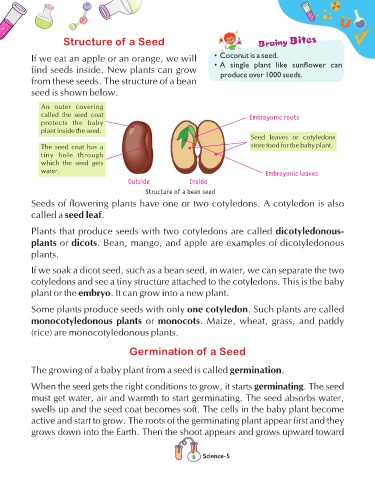
            from these seeds. The structure of a bean
            seed is shown below.

               An  outer  covering
               called  the  seed  coat                                                 Embroyonic roots
               protects  the  baby
               plant inside the seed.
                                                                                        Seed  leaves  or  cotyledons
               The seed coat has a                                                      store food for the baby plant.
               tiny  hole  through
               which  the  seed  gets
               water.                                                                        Embroyonic leaves
                                             Outside              Inside
                                                   Structure of a bean seed

            Seeds of flowering plants have one or two cotyledons. A cotyledon is also
            called a seed leaf.

            Plants that produce seeds with two cotyledons are called dicotyledonous-

            plants or dicots. Bean, mango, and apple are examples of dicotyledonous

            plants.

            If we soak a dicot seed, such as a bean seed, in water, we can separate the two
            cotyledons and see a tiny structure attached to the cotyledons. This is the baby

            plant or the embryo. It can grow into a new plant.

            Some plants produce seeds with only one cotyledon. Such plants are called

            monocotyledonous plants or monocots. Maize, wheat, grass, and paddy
            (rice) are monocotyledonous plants.


                                              Germination of a Seed

            The growing of a baby plant from a seed is called germination.


            When the seed gets the right conditions to grow, it starts germinating. The seed
            must get water, air and warmth to start germinating. The seed absorbs water,

            swells up and the seed coat becomes soft. The cells in the baby plant become
            active and start to grow. The roots of the germinating plant appear first and they

            grows down into the Earth. Then the shoot appears and grows upward toward


                                                                   8   Science-5

