


Page 102 - M. Abrahim Thesis
P. 102
Chapter (4) Network Design


                   The minimum number of bits that can be borrowed is 2. If you were to borrow only 1 bit, to
            create a subnet, you would have only a network number (the .0 network) and a broadcast number
            (the .255 network). The maximum number of bits that can be borrowed can be any number that
            leaves at least 2 bits for the host number.
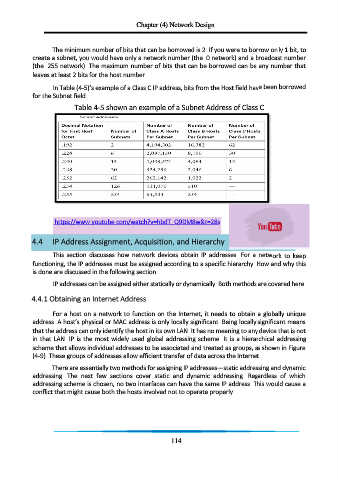
                   In Table (4-5)’s example of a Class C IP address, bits from the Host field have been borrowed
            for the Subnet field.

                           Table 4-5 shown an example of a Subnet Address of Class C


                    https://www.youtube.com/watch?v=hbdT_Q9DM8w&t=28s


            4.4   IP Address Assignment, Acquisition, and Hierarchy

                   This  section  discusses  how  network  devices  obtain  IP  addresses.  For  a  network  to  keep
            functioning, the IP addresses must be assigned according to a specific hierarchy. How and why this
            is done are discussed in the following section.

                   IP addresses can be assigned either statically or dynamically. Both methods are covered here.

            4.4.1 Obtaining an Internet Address

                   For a host on a network to function on the Internet, it needs to obtain a globally unique
            address. A host’s physical or MAC address is only locally significant. Being locally significant means
            that the address can only identify the host in its own LAN. It has no meaning to any device that is not
            in that LAN. IP is the most widely used global addressing scheme. It is a hierarchical addressing
            scheme that allows individual addresses to be associated and treated as groups, as shown in Figure
            (4-9). These groups of addresses allow efficient transfer of data across the Internet.

                   There are essentially two methods for assigning IP addresses—static addressing and dynamic
            addressing.  The  next  few  sections  cover  static  and  dynamic  addressing.  Regardless  of  which
            addressing scheme is chosen, no two interfaces can have the same IP address. This would cause a
            conflict that might cause both the hosts involved not to operate properly.


                                                             114

