


Page 44 - M. Abrahim Thesis
P. 44
Chapter (2) Network Fundamental and Layered Network Architecture


                connectivity  to  other  parts  (segments)  of  the  LAN  for  traffic  that  is  directed  there.  Every
                networking device has a unique MAC address on the NIC.

                        The bridge keeps track of which MAC addresses are on each side of the bridge and makes
                forwarding decisions based on this MAC address list. Bridges filter network traffic by looking only
                at the MAC address. Therefore, they can rapidly forward traffic representing any network layer
                protocol. Because bridges look only at MAC addresses, they are not concerned with network
                layer protocols. Consequently, bridges are concerned only with passing or not passing frames,
                based on their destination MAC addresses.
                The following are the important properties of bridges:


                         •  Bridges are more “intelligent” than hubs. That is, they can analyze incoming frames
                             and forward (or drop) them based on addressing information.
                         •  Bridges collect and pass packets between two or more LAN segments.
                         •  Bridges create more collision domains, allowing more than one device to transmit
                             simultaneously without causing a collision.
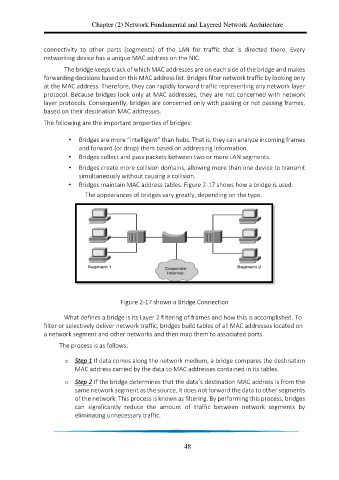
                         •  Bridges maintain MAC address tables. Figure 2-17 shows how a bridge is used.
                               The appearances of bridges vary greatly, depending on the type.


                                           Figure 2-17 shown a Bridge Connection

                        What defines a bridge is its Layer 2 filtering of frames and how this is accomplished. To
                filter or selectively deliver network traffic, bridges build tables of all MAC addresses located on
                a network segment and other networks and then map them to associated ports.
                          The process is as follows:

                        o  Step 1 If data comes along the network medium, a bridge compares the destination
                           MAC address carried by the data to MAC addresses contained in its tables.

                        o  Step 2 If the bridge determines that the data’s destination MAC address is from the
                           same network segment as the source, it does not forward the data to other segments
                           of the network. This process is known as filtering. By performing this process, bridges
                           can  significantly  reduce  the  amount  of  traffic  between  network  segments  by
                           eliminating unnecessary traffic.


                                                                  48

