


Page 46 - M. Abrahim Thesis
P. 46
Chapter (2) Network Fundamental and Layered Network Architecture


                decisions based on network addresses instead of individual Layer 2 MAC addresses. Routers also
                can connect different Layer 2 technologies, such as Ethernet, Token Ring, and Fiber Distributed
                Data Interface (FDDI). Routers also commonly connect Asynchronous Transfer Mode (ATM) and
                serial connections.
                        However, because of their capability to route packets based on Layer 3 information,
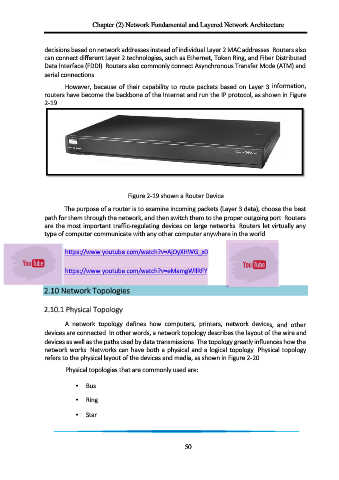
                routers have become the backbone of the Internet and run the IP protocol, as shown in Figure
                2-19.


                                              Figure 2-19 shown a Router Device

                        The purpose of a router is to examine incoming packets (Layer 3 data), choose the best
                path for them through the network, and then switch them to the proper outgoing port. Routers
                are the most important traffic-regulating devices on large networks. Routers let virtually any
                type of computer communicate with any other computer anywhere in the world.


                        https://www.youtube.com/watch?v=AjOyXHWG_x0


                        https://www.youtube.com/watch?v=eMamgWllRFY


                2.10 Network Topologies


                2.10.1 Physical Topology

                        A  network  topology  defines  how  computers,  printers,  network  devices,  and  other
                devices are connected. In other words, a network topology describes the layout of the wire and
                devices as well as the paths used by data transmissions. The topology greatly influences how the
                network works. Networks can have both a physical and a logical topology. Physical topology
                refers to the physical layout of the devices and media, as shown in Figure 2-20.
                        Physical topologies that are commonly used are:


                           •  Bus

                           •  Ring

                           •  Star


                                                                  50

