


Page 42 - M. Abrahim Thesis
P. 42
Chapter (2) Network Fundamental and Layered Network Architecture


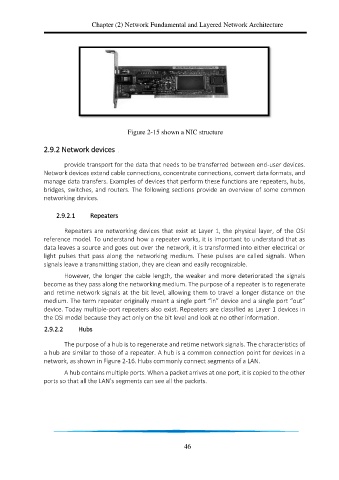
                                              Figure  2 - 15  shown a NIC structure


                2.9.2 Network devices

                        provide transport for the data that needs to be transferred between end-user devices.
                Network devices extend cable connections, concentrate connections, convert data formats, and
                manage data transfers. Examples of devices that perform these functions are repeaters, hubs,
                bridges, switches, and routers. The following sections provide an overview of some common
                networking devices.


                     2.9.2.1     Repeaters

                        Repeaters are networking devices that exist at Layer 1, the physical layer, of the OSI
                reference model. To understand how a repeater works, it is important to understand that as
                data leaves a source and goes out over the network, it is transformed into either electrical or
                light  pulses  that  pass  along  the  networking  medium.  These  pulses  are  called  signals.  When
                signals leave a transmitting station, they are clean and easily recognizable.

                        However, the longer the cable length, the weaker and more deteriorated the signals
                become as they pass along the networking medium. The purpose of a repeater is to regenerate
                and retime network signals at the bit level, allowing them to travel a longer distance on the
                medium. The term repeater originally meant a single port “in” device and a single port “out”
                device. Today multiple-port repeaters also exist. Repeaters are classified as Layer 1 devices in
                the OSI model because they act only on the bit level and look at no other information.

                 2.9.2.2     Hubs

                        The purpose of a hub is to regenerate and retime network signals. The characteristics of
                a hub are similar to those of a repeater. A hub is a common connection point for devices in a
                network, as shown in Figure 2-16. Hubs commonly connect segments of a LAN.

                        A hub contains multiple ports. When a packet arrives at one port, it is copied to the other
                ports so that all the LAN’s segments can see all the packets.


                                                                  46

