


Page 40 - M. Abrahim Thesis
P. 40
Chapter (2) Network Fundamental and Layered Network Architecture


                        Step 2 Package the data for end-to-end transport


                        The  data  is  packaged  for  internetwork  transport.  By  using  segments,  the  transport
                function ensures that the message hosts at both ends of the e-mail system can communicate
                reliably.

                        Step 3 Append (add) the network address to the header

                        The data is put into a packet or datagram that contains a network header with source
                and destination logical addresses. These addresses help network devices send the packets across
                the network along a chosen path.
                        Step 4 Append (add) the local address to the data link header

                        Each network device must put the packet into a frame. The frame allows connection to
                the next directly-connected network device on the link. Each device in the chosen network path
                requires framing to be connected to the next device.

                        Step 5 Convert to bits for transmission

                        A  clocking  function  lets  the  devices  distinguish  these  bits  as  they  travel  across  the
                medium. The medium on the physical internetwork can vary along the path used. For example,
                the e-mail message can originate on a LAN, cross a campus backbone, and go out a WAN link
                until it reaches its destination on another remote LAN. Headers and trailers are added as data
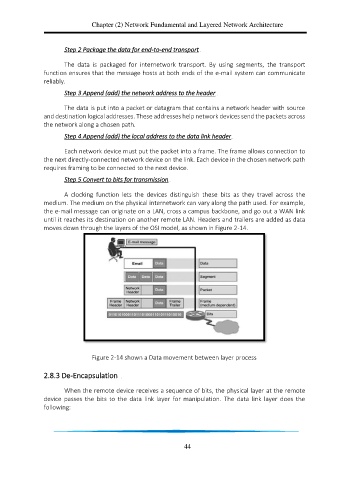
                moves down through the layers of the OSI model, as shown in Figure 2-14.


                                 Figure 2-14 shown a Data movement between layer process


                2.8.3 De-Encapsulation

                        When the remote device receives a sequence of bits, the physical layer at the remote
                device  passes  the  bits  to  the  data  link  layer  for  manipulation.  The  data  link  layer  does  the
                following:


                                                                  44

