


Page 43 - M. Abrahim Thesis
P. 43
Computer Network                                                             2021


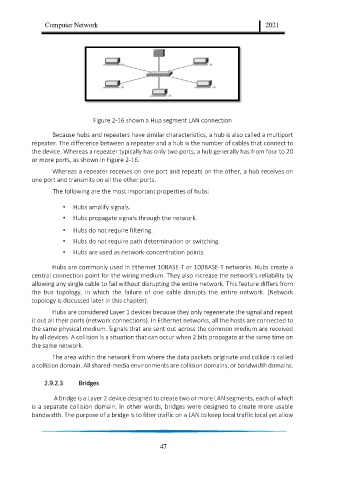
                                  Figure 2-16 shown a Hup segment LAN connection

                   Because hubs and repeaters have similar characteristics, a hub is also called a multiport
            repeater. The difference between a repeater and a hub is the number of cables that connect to
            the device. Whereas a repeater typically has only two ports, a hub generally has from four to 20
            or more ports, as shown in Figure 2-16.

                   Whereas a repeater receives on one port and repeats on the other, a hub receives on
            one port and transmits on all the other ports.
                    The following are the most important properties of hubs:


                       •  Hubs amplify signals.
                       •  Hubs propagate signals through the network.

                       •  Hubs do not require filtering.
                       •  Hubs do not require path determination or switching.

                       •  Hubs are used as network-concentration points.

                   Hubs are commonly used in Ethernet 10BASE-T or 100BASE-T networks. Hubs create a
            central connection point for the wiring medium. They also increase the network’s reliability by
            allowing any single cable to fail without disrupting the entire network. This feature differs from
            the  bus  topology,  in  which  the  failure  of  one  cable  disrupts  the  entire  network.  (Network
            topology is discussed later in this chapter).

                   Hubs are considered Layer 1 devices because they only regenerate the signal and repeat
            it out all their ports (network connections). In Ethernet networks, all the hosts are connected to
            the same physical medium. Signals that are sent out across the common medium are received
            by all devices. A collision is a situation that can occur when 2 bits propagate at the same time on
            the same network.

                   The area within the network from where the data packets originate and collide is called
            a collision domain. All shared-media environments are collision domains, or bandwidth domains.

                 2.9.2.3     Bridges


                    A bridge is a Layer 2 device designed to create two or more LAN segments, each of which
            is a separate collision domain. In other words, bridges were designed to create more usable
            bandwidth. The purpose of a bridge is to filter traffic on a LAN to keep local traffic local yet allow


                                                         47

