


Page 84 - M. Abrahim Thesis
P. 84
CHAPTER 4


                                                NETWORK DESIGN


            4.1   Internet Architecture
                   Although  the  Internet  is  complex,  some  basic  ideas  underlie  its  operation.  This  section
            investigates the basic architecture of the Internet—a deceptively simple idea that, when repeated
            on a large scale, enables nearly instantaneous worldwide data communications between anyone,
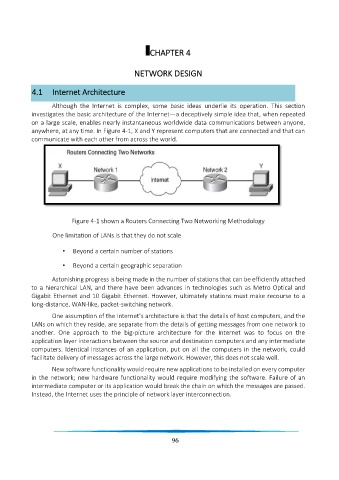
            anywhere, at any time. In Figure 4-1, X and Y represent computers that are connected and that can
            communicate with each other from across the world.


                          Figure 4-1 shown a Routers Connecting Two Networking Methodology

                   One limitation of LANs is that they do not scale

                       •  Beyond a certain number of stations


                       •  Beyond a certain geographic separation

                   Astonishing progress is being made in the number of stations that can be efficiently attached
            to a hierarchical LAN, and there have been advances in technologies such as Metro Optical and
            Gigabit Ethernet and 10 Gigabit Ethernet. However, ultimately stations must make recourse to a
            long-distance, WAN-like, packet-switching network.

                   One assumption of the Internet’s architecture is that the details of host computers, and the
            LANs on which they reside, are separate from the details of getting messages from one network to
            another.  One  approach  to  the  big-picture  architecture  for  the  Internet  was  to  focus  on  the
            application layer interactions between the source and destination computers and any intermediate
            computers. Identical instances of an application, put on all the computers in the network, could
            facilitate delivery of messages across the large network. However, this does not scale well.
                   New software functionality would require new applications to be installed on every computer
            in the network; new hardware functionality would require modifying the software. Failure of an
            intermediate computer or its application would break the chain on which the messages are passed.
            Instead, the Internet uses the principle of network layer interconnection.


                                                             96

