


Page 89 - M. Abrahim Thesis
P. 89
Computer Network                                                             2021


            might have the address 128.10.2.1. This way of writing the address is called dotteddecimal format.
            In this notation, each IP address is written as four parts separated by periods, or dots. Each part of
            the address is called an octet because it is made up of 8 binary digits.
                   For  example,  the  IP  address  192.168.1.8  is  11000000.10101000.00000001.00001000  in
            binary notation. It is plain to see that it is easier for humans to understand dotted-decimal notation
            instead of the binary 1s and 0s. This prevents a large number of transposition errors that would result
            if only the binary numbers were used.
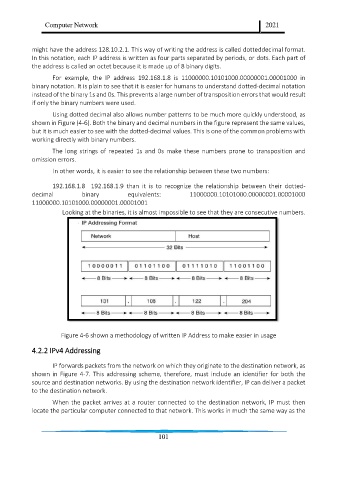
                   Using dotted decimal also allows number patterns to be much more quickly understood, as
            shown in Figure (4-6). Both the binary and decimal numbers in the figure represent the same values,
            but it is much easier to see with the dotted-decimal values. This is one of the common problems with
            working directly with binary numbers.
                   The  long  strings  of  repeated  1s  and  0s  make  these  numbers  prone  to  transposition  and
            omission errors.

                    In other words, it is easier to see the relationship between these two numbers:

                   192.168.1.8    192.168.1.9  than  it  is  to  recognize  the  relationship  between  their  dotted-
            decimal           binary          equivalents:          11000000.10101000.00000001.00001000
            11000000.10101000.00000001.00001001
                       Looking at the binaries, it is almost impossible to see that they are consecutive numbers.


                      Figure 4-6 shown a methodology of written IP Address to make easier in usage

            4.2.2 IPv4 Addressing


                   IP forwards packets from the network on which they originate to the destination network, as
            shown in Figure 4-7. This addressing scheme, therefore, must include an identifier for both the
            source and destination networks. By using the destination network identifier, IP can deliver a packet
            to the destination network.

                   When the packet arrives at a router connected to the destination network, IP must then
            locate the particular computer connected to that network. This works in much the same way as the


                                                         101

