


Page 92 - M. Abrahim Thesis
P. 92
Chapter (4) Network Design


                   The assumption was that there would be a relatively small number of large networks, possibly
            with millions of computers.

                   The  designers  envisioned  a  larger  number  of  medium-sized  networks,  with  perhaps
            thousands of computers each.

                       Finally, they saw a great number of networks having several hundred or fewer machines.

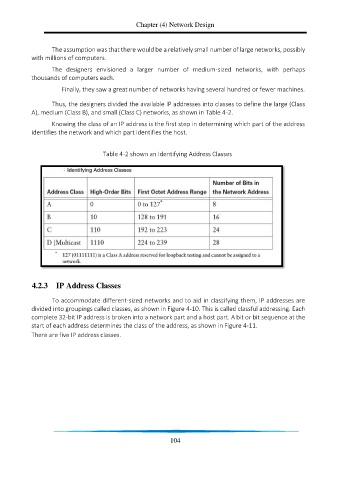
                   Thus, the designers divided the available IP addresses into classes to define the large (Class
            A), medium (Class B), and small (Class C) networks, as shown in Table 4-2.
                   Knowing the class of an IP address is the first step in determining which part of the address
            identifies the network and which part identifies the host.


                                     Table 4-2 shown an Identifying Address Classes


            4.2.3  IP Address Classes

                   To accommodate different-sized networks and to aid in classifying them, IP addresses are
            divided into groupings called classes, as shown in Figure 4-10. This is called classful addressing. Each
            complete 32-bit IP address is broken into a network part and a host part. A bit or bit sequence at the
            start of each address determines the class of the address, as shown in Figure 4-11.
            There are five IP address classes.


                                                             104

