


Page 155 - Towards A Sustainable Future , Phase 3 2025, E-Book_Neat
P. 155
New abrasive detergent (estimated):                  2. Generate economic benefits: Reduce waste disposal costs
            Shell powder (57.5%): Significantly lower emissions   and create a new revenue stream.
            due to upcycling                                     3.  Enhance  culinary  offerings:  Produce  a  nutritious  and
            Surfactants (18.75%): Similar emissions to traditional   flavourful  seasoning  powder  rich  in  calcium  and  protein,
            detergents                                           suitable for various dishes.
            Other ingredients (23.75%): Similar emissions to traditional   This initiative aligns with the principles of a circular economy,
            detergents                                           demonstrating  ParkRoyal's  commitment  to  sustainability
                                                                 within the hospitality sector.
            An estimation value will be,
            (0.5 X 0.575) + (1 x 0.1875) + (1 x 0.2375) = 0.7125 times the   Formulation
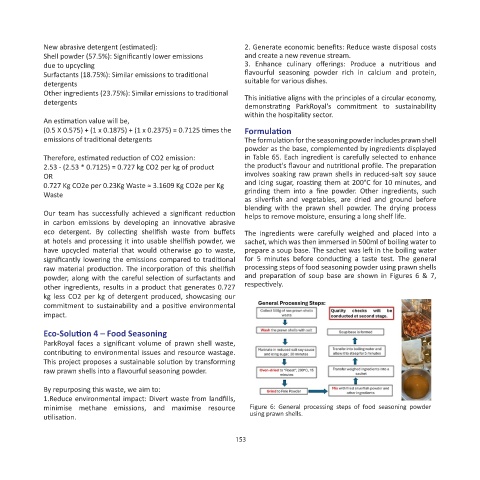
            emissions of traditional detergents                  The formulation for the seasoning powder includes prawn shell
                                                                 powder as the base, complemented by ingredients displayed
            Therefore, estimated reduction of CO2 emission:      in Table 65. Each ingredient is carefully selected to enhance
            2.53 - (2.53 * 0.7125) = 0.727 kg CO2 per kg of product   the product's flavour and nutritional profile. The preparation
            OR                                                   involves soaking raw prawn shells in reduced-salt soy sauce
            0.727 Kg CO2e per 0.23Kg Waste ≈ 3.1609 Kg CO2e per Kg   and icing sugar, roasting them at 200°C for 10 minutes, and
            Waste                                                grinding  them  into  a  fine  powder.  Other  ingredients,  such
                                                                 as  silverfish  and  vegetables,  are  dried  and  ground  before
                                                                 blending  with  the  prawn  shell  powder.  The  drying  process
            Our  team  has  successfully  achieved  a  significant  reduction   helps to remove moisture, ensuring a long shelf life.
            in  carbon  emissions  by  developing  an  innovative  abrasive
            eco  detergent.  By  collecting  shellfish  waste  from  buffets   The  ingredients  were  carefully  weighed  and  placed  into  a
            at hotels and processing it into usable shellfish powder, we  sachet, which was then immersed in 500ml of boiling water to
            have  upcycled  material  that  would  otherwise  go  to  waste,  prepare a soup base. The sachet was left in the boiling water
            significantly lowering the emissions compared to traditional  for  5  minutes  before  conducting  a  taste  test.  The  general
            raw  material  production.  The  incorporation  of  this  shellfish   processing steps of food seasoning powder using prawn shells
            powder, along with the careful selection of surfactants and   and  preparation  of  soup  base  are  shown  in  Figures  6  &  7,
            other ingredients, results in a product that generates 0.727   respectively.
            kg  less  CO2  per  kg  of  detergent  produced,  showcasing  our
            commitment  to  sustainability  and  a  positive  environmental
            impact.

            Eco-Solution 4 – Food Seasoning
            ParkRoyal  faces  a  significant  volume  of  prawn  shell  waste,
            contributing to environmental issues and resource wastage.
            This project proposes a sustainable solution by transforming
            raw prawn shells into a flavourful seasoning powder.

            By repurposing this waste, we aim to:
            1.Reduce environmental impact: Divert waste from landfills,
            minimise  methane  emissions,  and  maximise  resource   Figure  6:  General  processing  steps  of  food  seasoning  powder
            utilisation.                                          using prawn shells.


                                                              153

