


Page 178 - MAT KS3 Y8 Cambridge CheckPoint
P. 178
17.6 Using nets of solids to work out surface areas


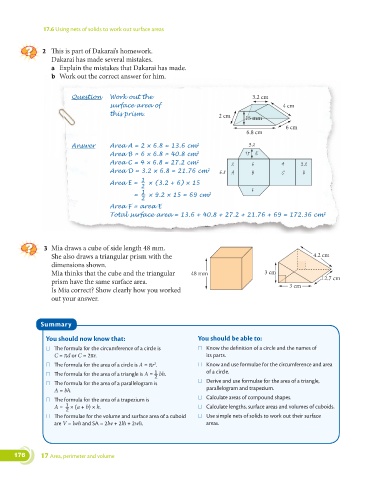
               2  This is part of Dakarai’s homework.
                  Dakarai has made several mistakes.
                  a  Explain the mistakes that Dakarai has made.
                  b  Work out the correct answer for him.
                  b Work out the correct answer for him.


                         Question     Work out the                                   3.2 cm
                                      surface area of                                          4 cm
                                      this prism.
                                                                          2 cm
                                                                                   15 mm
                                                                                                6 cm
                                                                                   6.8 cm

                         Answer       Area A = 2 × 6.8 = 13.6 cm   2
                                      Area B = 6 × 6.8 = 40.8 cm   2
                                      Area C = 4 × 6.8 = 27.2 cm   2
                                      Area D = 3.2 × 6.8 = 21.76 cm   2
                                      Area E =   1   × (3.2 + 6) × 15
                                                2
                                              =  1   × 9.2 × 15 = 69 cm 2
                                                2
                                      Area F = area E
                                      Total surface area = 13.6 + 40.8 + 27.2 + 21.76 + 69 = 172.36 cm       2


                3  Mia draws a cube of side length 48 mm.
                    She also draws a triangular prism with the                                            4.2 cm
                  dimensions shown.
                    Mia thinks that the cube and the triangular    48 mm                 3 cm
                                                                                                            12.7 cm
                  prism have the same surface area.
                                                                                                  3 cm
                    Is Mia correct? Show clearly how you worked
                  out your answer.


               Summary

                You should now know that:                          You should be able to:
                    The formula for the circumference of a circle is       Know the definition of a circle and the names of
                   C = πd or C = 2πr.                                 its parts.
                    The formula for the area of a circle is A = πr .       Know and use formulae for the circumference and area
                                                     2
                    The formula for the area of a triangle is A =  1 2  bh.  of a circle.
                    The formula for the area of a parallelogram is        Derive and use formulae for the area of a triangle,
                                                                      parallelogram and trapezium.
                   A = bh.
                    The formula for the area of a trapezium is         Calculate areas of compound shapes.
                   A =   1 2  × (a + b) × h.                           Calculate lengths, surface areas and volumes of cuboids.
                    The formulae for the volume and surface area of a cuboid       Use simple nets of solids to work out their surface
                   are V = lwh and SA = 2lw + 2lh + 2wh.              areas.


      176      17 Area, perimeter and volume
      176

