


Page 335 - Ranah Studi Agraria: Penguasaan Tanah dan Hubungan Agraris
P. 335
Ranah Studi Agraria

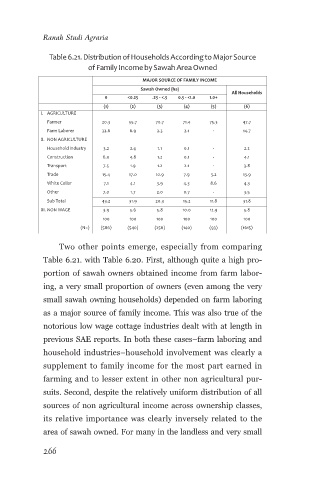
             Table 6.21. Distribution of Households According to Major Source
                       of Family Income by Sawah Area Owned
                                    MAJOR SOURCE OF FAMILY INCOME
                                    Sawah Owned (ha)
                                                           All Households
                           0     <0.25  .25 - <.5  0.5 - <1.0  1.0+
                           (1)   (2)    (3)    (4)   (5)      (6)
           I. AGRICULTURE
             Farmer       20.3   55.7   70.7  71.4   75.3    47.7
             Farm Laborer  32.6  6.9    2.3    2.1    -      14.7
           II. NON AGRICULTURE
             Household industry  3.2  2.4  1.1  0.1   -       2.2
             Construction  6.0   4.8    1.2    0.1    -       4.1
             Transport     7.5   1.9    1.2    2.1    -       3.8
             Trade        15.4   17.0   10.9   7.9   3.2     13.9
             White Collar  7.1   4.1    3.9    4.3   8.6      4.3
             Other         7.0   1.7    2.0    0.7    -       3.5
             Sub Total    43.2   31.9   20.3   15.2  11.8    31.8
           III. NON WAGE   3.9   5.6    5.8   10.0   12.9     5.8
                           100   100    100    100   100      100
                     (N=)  (586)  (540)  (256)  (140)  (93)  (1615)

                Two other points emerge, especially from comparing
            Table 6.21. with Table 6.20. First, although quite a high pro-
            portion of sawah owners obtained income from farm labor-
            ing, a very small proportion of owners (even among the very
            small sawah owning households) depended on farm laboring
            as a major source of family income. This was also true of the
            notorious low wage cottage industries dealt with at length in
            previous SAE reports. In both these cases–farm laboring and
            household industries–household involvement was clearly a
            supplement to family income for the most part earned in
            farming and to lesser extent in other non agricultural pur-
            suits. Second, despite the relatively uniform distribution of all
            sources of non agricultural income across ownership classes,
            its relative importance was clearly inversely related to the
            area of sawah owned. For many in the landless and very small

            266

