


Page 338 - Ranah Studi Agraria: Penguasaan Tanah dan Hubungan Agraris
P. 338
Landownership Tenancy, and ...

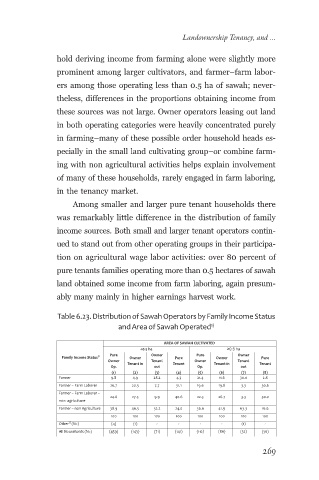
               hold deriving income from farming alone were slightly more
               prominent among larger cultivators, and farmer–farm labor-
               ers among those operating less than 0.5 ha of sawah; never-
               theless, differences in the proportions obtaining income from

               these sources was not large. Owner operators leasing out land
               in both operating categories were heavily concentrated purely
               in farming–many of these possible order household heads es-
               pecially in the small land cultivating group–or combine farm-
               ing with non agricultural activities helps explain involvement
               of many of these households, rarely engaged in farm laboring,
               in the tenancy market.
                   Among smaller and larger pure tenant households there
               was remarkably little difference in the distribution of family
               income sources. Both small and larger tenant operators contin-
               ued to stand out from other operating groups in their participa-
               tion on agricultural wage labor activities: over 80 percent of
               pure tenants families operating more than 0.5 hectares of sawah
               land obtained some income from farm laboring, again presum-
               ably many mainly in higher earnings harvest work.

               Table 6.23. Distribution of Sawah Operators by Family Income Status
                              and Area of Sawah Operated 1)

                                          AREA OF SAWAH CULTIVATED
                                    <0.5 ha              ≥0.5 ha
                Family Income Status 1)  Pure  Owner  Owner  Pure  Pure  Owner  Owner  Pure
                            Owner      Tenant    Owner      Tenant
                                 Tenant in  Tenant    Tenant in   Tenant
                             Op.       out        Op.        out
                             (1)  (2)   (3)  (4)  (5)   (6)  (7)  (8)
                Farmer       9.8  4.9  28.2  4.3  21.4  11.6  30.0  2.8
                Farmer – Farm Laborer  26.7  20.5  7.7  31.1  19.6  19.8  3.3  30.6
                Farmer – Farm Laborer –
                            24.6  27.5  9.9  40.6  22.3  26.7  3.3  50.0
                non- agriculture
                Farmer – non Agriculture  38.9  46.5  52.2  24.0  36.6  41.9  63.3  16.6
                             100  100  100   100  100  100   100  100
                  2)
                Other (N=)   (4)  (1)   -    -     -    -    (1)   -
                All Households (N=)  (459)  (143)  (71)  (141)  (112)  (86)  (32)  (36)
                                                                  269

