


Page 664 - Economics
P. 664
CONFIRMING PAGES


                                                                                                                CHAPTER 29
                                                                                                                          573
                                                                                        Public Choice Theory and the Economics of Taxation
                     by differences in property-tax rates from locality to local-    Division of Burden     Since the government im-
                     ity. In general, property-tax rates are higher in poorer   poses the tax on the sellers (suppliers), we can view the
                     areas, to make up for lower property values.        tax as an addition to the marginal cost of the product.
                                                                         Now sellers must get $2 more for each bottle to receive
                       Tax Incidence and Efficiency                      the same per-unit profit they were getting before the tax.
                                                                         While sellers are willing to offer, for example, 5 million
                     Loss                                                bottles of untaxed wine at $4 per bottle, they must now
                       Determining whether a particular tax is progressive, pro-  receive $6 per bottle (  $4   $2 tax) to offer the same
                     portional, or regressive is complicated, because those on   5 million bottles. The tax shifts the supply curve upward
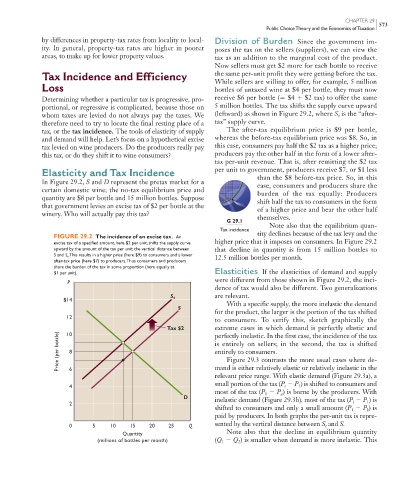
                     whom taxes are levied do not always pay the taxes. We   (leftward) as shown in  Figure 29.2 , where  S  t      is the “after-
                     therefore need to try to locate the final resting place of a   tax” supply curve.
                     tax, or the   tax incidence   .  The tools of elasticity of supply        The after-tax equilibrium price is $9 per bottle,
                     and demand will help. Let’s focus on a hypothetical excise   whereas the before-tax equilibrium price was $8. So, in
                     tax levied on wine producers. Do the producers really pay   this case, consumers pay half the $2 tax as a higher price;
                     this tax, or do they shift it to wine consumers?    producers pay the other half in the form of a lower after-
                                                                         tax per-unit revenue. That is, after remitting the $2 tax
                       Elasticity and Tax Incidence                      per unit to government, producers receive $7, or $1 less
                       In  Figure 29.2 ,  S  and  D  represent the pretax market for a   than the $8 before-tax price. So, in this
                                                                                      case, consumers and producers share the
                     certain domestic wine; the no-tax equilibrium price and          burden of the tax equally: Producers
                     quantity are $8 per bottle and 15 million bottles. Suppose       shift half the tax to consumers in the form
                     that government levies an excise tax of $2 per bottle at the     of a higher price and bear the other half
                     winery. Who will actually pay this tax?
                                                                            G 29.1    themselves.
                                                                                           Note also that the equilibrium quan-
                                                                          Tax incidence
                                                                                      tity declines because of the tax levy and the
                        FIGURE 29.2   The incidence of an excise tax.    An
                        excise tax of a specified amount, here $2 per unit, shifts the supply curve   higher price that it imposes on consumers. In  Figure 29.2
                        upward by the amount of the tax per unit: the vertical distance between   that decline in quantity is from 15 million bottles to
                          S  and  S  t   . This results in a higher price (here $9) to consumers and a lower
                        after-tax price (here $7) to producers. Thus consumers and producers   12.5 million bottles per month.
                        share the burden of the tax in some proportion (here equally at
                        $1 per unit).                                      Elasticities     If the elasticities of demand and supply
                             P                                           were different from those shown in  Figure 29.2 , the inci-
                                                                         dence of tax would also be different. Two generalizations
                                                            S t          are relevant.
                           $14                                                With a specific supply, the more inelastic the demand
                                                              S
                                                                         for the product, the larger is the portion of the tax shifted
                            12
                                                                         to consumers. To verify this, sketch graphically the
                                                           Tax $2        extreme cases in which demand is perfectly elastic and
                          Price (per bottle)  8                          is entirely on sellers; in the second, the tax is shifted
                            10
                                                                         perfectly inelastic. In the first case, the incidence of the tax
                                                                         entirely to consumers.

                                                                            Figure 29.3  contrasts the more usual cases where de-
                                                                         mand is either relatively elastic or relatively inelastic in the
                             6
                                                                         relevant price range. With elastic demand ( Figure 29.3a ), a
                                                                         small portion of the tax ( P       P   ) is shifted to consumers and
                             4                                                                e   1
                                                                         most of the tax ( P       P   ) is borne by the producers. With
                                                                                        1
                                                                                             a
                                                               D         inelastic demand ( Figure 29.3b ), most of the tax ( P       P   ) is
                             2                                                                                    i    1
                                                                         shifted to consumers and only a small amount ( P       P   ) is
                                                                                                                       b
                                                                                                                  1
                                                                         paid by producers. In both graphs the per-unit tax is repre-
                             0      5    10    15    20    25    Q       sented by the vertical distance between  S  t      and  S.
                                             Quantity                         Note also that the decline in equilibrium quantity
                                      (millions of bottles per month)    ( Q       Q   ) is smaller when demand is more inelastic. This
                                                                                2
                                                                           1


          mcc26632_ch29_564-580.indd   573                                                                             9/10/06   9:41:04 PM
                                                                                                                       9/10/06   9:41:04 PM
          mcc26632_ch29_564-580.indd   573

