


Page 665 - Economics
P. 665
CONFIRMING PAGES


                  PART EIGHT
              574
                  Microeconomics of Government
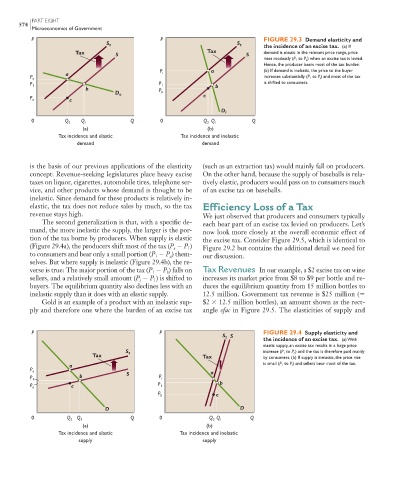
                  P                                      P                              FIGURE 29.3   Demand elasticity and
                                        S t                                     S t
                                                                                        the incidence of an excise tax.    (a) If
                               Tax         S                           Tax        S     demand is elastic in the relevant price range, price
                                                                                        rises modestly ( P   1   to  P  e   ) when an excise tax is levied.
                                                                                        Hence, the producer bears most of the tax burden.
                                                                        a               (b) If demand is inelastic, the price to the buyer
                            a                           P i
                 P e                                                                    increases substantially ( P   1   to  P  i   ) and most of the tax
                                                                                        is shifted to consumers.
                 P 1                                    P 1              b
                                  b
                                           D e          P b          c
                             c
                 P a
                                                                           D i
                  0         Q 2  Q 1           Q        0            Q 2  Q 1       Q
                                 (a)                                   (b)
                          Tax incidence and elastic            Tax incidence and inelastic
                               demand                                demand


                 is the basis of our previous applications of the elasticity   (such as an extraction tax) would mainly fall on producers.
                 concept: Revenue-seeking legislatures place heavy excise   On the other hand, because the supply of baseballs is rela-
                 taxes on liquor, cigarettes, automobile tires, telephone ser-  tively elastic, producers would pass on to consumers much
                 vice, and other products whose demand is thought to be   of an excise tax on baseballs.
                 inelastic. Since demand for these products is relatively in-
                 elastic, the tax does not reduce sales by much, so the tax     Efficiency Loss of a Tax
                 revenue stays high.                                   We just observed that producers and consumers typically
                      The second generalization is that, with a specific de-  each bear part of an excise tax levied on producers. Let’s
                 mand, the more inelastic the supply, the larger is the por-  now look more closely at the overall economic effect of
                 tion of the tax borne by producers. When supply is elastic   the excise tax. Consider  Figure 29.5 , which is identical to
                 ( Figure 29.4a ), the producers shift most of the tax ( P       P   )     Figure 29.2  but contains the additional detail we need for
                                                                 1
                                                            e
                 to consumers and bear only a small portion ( P       P   ) them-  our discussion.
                                                       1
                                                           a
                 selves. But where supply is inelastic ( Figure 29.4b ), the re-
                 verse is true: The major portion of the tax ( P       P   ) falls on     Tax Revenues     In our example, a $2 excise tax on wine
                                                      1
                                                          b
                 sellers, and a relatively small amount ( P       P   ) is shifted to   increases its market price from $8 to $9 per bottle and re-
                                                  i
                                                      1
                 buyers. The equilibrium quantity also declines less with an   duces the equilibrium quantity from 15 million bottles to
                 inelastic supply than it does with an elastic supply.   12.5 million. Government tax revenue is $25 million (
                      Gold is an example of a product with an inelastic sup-  $2   12.5 million bottles), an amount shown as the rect-
                 ply and therefore one where the burden of an excise tax   angle  efac  in  Figure 29.5 . The elasticities of supply and
                  P                                     P                              FIGURE 29.4  Supply elasticity and
                                                                           S t S
                                                                                       the incidence of an excise tax.   (a) With
                                                                                       elastic supply, an excise tax results in a large price
                                              S t                                      increase ( P   1   to  P  e   ) and the tax is therefore paid mainly
                                    Tax                              Tax               by consumers. (b) If supply is inelastic, the price rise
                             a                                                         is small ( P   1   to  P  i   ) and sellers bear most of the tax.
                 P e                          S                         a
                                b
                 P 1                                    P i
                                                                          b
                              c                         P 1
                 P a
                                                                         c
                                                        P b
                                        D                                       D
                  0         Q 2 Q 1            Q        0              Q 2 Q 1      Q
                                 (a)                                  (b)
                          Tax incidence and elastic           Tax incidence and inelastic
                                supply                               supply


                                                                                                                       9/10/06   9:41:04 PM
          mcc26632_ch29_564-580.indd   574                                                                             9/10/06   9:41:04 PM
          mcc26632_ch29_564-580.indd   574

