


Page 226 - American Stories, A History of the United States
P. 226
protected them from seizure and deprived the European powers of needed Ameri-
                    can goods, especially food. The president predicted that a total embargo of American                   8.1
                    commerce would soon force Britain and France to negotiate with the United States in
                    good faith: “Our commerce is so valuable to them that they will be glad to purchase
                    it when the only price we ask is to do us justice.” The Embargo Act became law on    embargo Act  In response to a   8.2
                                                                                               British attack on an American
                    December 22, 1807.                                                         warship off the coast of virginia,
                       But “peaceable coercion” became a Jeffersonian nightmare. The president naively   this 1807 law prohibited foreign
                    believed the American people would enthusiastically support the embargo. Instead,   commerce.          8.3
                    compliance required enforcement acts that became increasingly harsh.
                       By mid-1808, Jefferson and Gallatin were regulating the smallest details of American
                    economic life. The federal government supervised the coastal trade, lest a ship sailing                8.4
                    between two states slip away to Europe or the West Indies. Overland trade with Canada
                    was proscribed. When violations still occurred, Congress gave customs collectors the
                    right to seize a vessel merely on suspicion of wrongdoing. A final desperate act in January
                    1809 prohibited the loading of any U.S. vessel, regardless of size, without authorization              8.5
                    from a customs officer who was supported by the army, navy, and local militia.
                       Northerners hated the embargo. Persons near Lake Champlain in upper New York
                    State simply ignored the regulations and roughed up customs officers who interfered
                    with the Canadian trade. The administration was determined to stop the smugglers.
                    Jefferson urged the governor of New York to call out the militia and sent federal troops
                    to overawe the citizens of New York.
                       New Englanders considered the embargo lunacy. New England merchants were
                    willing to take their chances on the high seas, but for reasons that few people under-
                    stood, the president insisted that it was better to preserve ships from possible seizure
                    than to make profits. Sailors and artisans were thrown out of work. The popular press
                    maintained a constant howl of protest. Not surprisingly, the Federalist Party revived in
                    New England. Extremists suggested that state assemblies nullify federal law.
                       By 1809, Jefferson’s foreign policy was bankrupt. The embargo never seriously
                    damaged the British economy. In fact, British merchants took over lucrative markets
                    that the Americans had been forced to abandon. Napoleon liked the embargo, since it


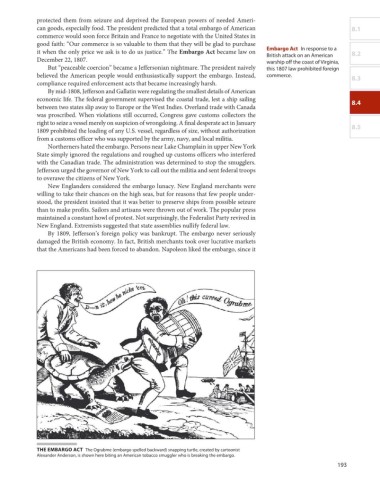
                    the eMBArGo ACt  The Ograbme (embargo spelled backward) snapping turtle, created by cartoonist
                    Alexander Anderson, is shown here biting an American tobacco smuggler who is breaking the embargo.
                                                                                                                       193

