


Page 228 - American Stories, A History of the United States
P. 228
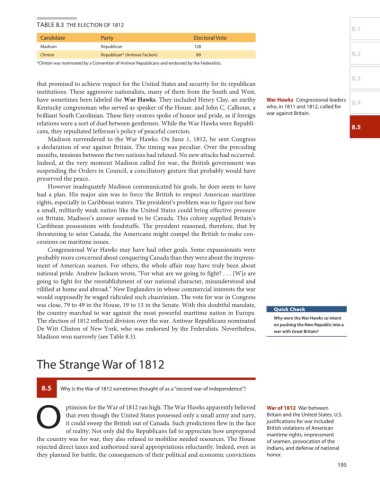
TABLE 8.3  THE ELECTION OF 1812
                                                                                                                           8.1
                     Candidate           Party                         Electoral vote
                     Madison             Republican                    128
                     Clinton             Republican* (Antiwar Faction)    89                                               8.2
                    *Clinton was nominated by a Convention of Antiwar Republicans and endorsed by the Federalists.

                                                                                                                           8.3
                    that promised to achieve respect for the United States and security for its republican
                    institutions. These aggressive nationalists, many of them from the South and West,
                    have sometimes been labeled the War Hawks. They included Henry Clay, an earthy   War hawks  Congressional leaders   8.4
                    Kentucky congressman who served as speaker of the House, and John C. Calhoun, a   who, in 1811 and 1812, called for
                    brilliant South Carolinian. These fiery orators spoke of honor and pride, as if foreign   war against Britain.
                    relations were a sort of duel between gentlemen. While the War Hawks were Republi-
                    cans, they repudiated Jefferson’s policy of peaceful coercion.                                         8.5
                       Madison surrendered to the War Hawks. On June 1, 1812, he sent Congress
                    a declaration of war against Britain. The timing was peculiar. Over the preceding
                    months, tensions between the two nations had relaxed. No new attacks had occurred.
                    Indeed, at the very moment Madison called for war, the British government was
                    suspending the Orders in Council, a conciliatory gesture that probably would have
                    preserved the peace.
                       However inadequately Madison communicated his goals, he does seem to have
                    had a plan. His major aim was to force the British to respect American maritime
                    rights, especially in Caribbean waters. The president’s problem was to figure out how
                    a small, militarily weak nation like the United States could bring effective pressure
                    on Britain. Madison’s answer seemed to be Canada. This colony supplied Britain’s
                      Caribbean possessions with foodstuffs. The president reasoned, therefore, that by
                    threatening to seize Canada, the Americans might compel the British to make con-
                    cessions on maritime issues.
                       Congressional War Hawks may have had other goals. Some expansionists were
                    probably more concerned about conquering Canada than they were about the impress-
                    ment of American seamen. For others, the whole affair may have truly been about
                    national pride. Andrew Jackson wrote, “For what are we going to fight? . . . [W]e are
                    going to fight for the reestablishment of our national character, misunderstood and
                    vilified at home and abroad.” New Englanders in whose commercial interests the war
                    would supposedly be waged ridiculed such chauvinism. The vote for war in Congress
                    was close, 79 to 49 in the House, 19 to 13 in the Senate. With this doubtful mandate,
                    the country marched to war against the most powerful maritime nation in Europe.   Quick Check
                    The election of 1812 reflected division over the war. Antiwar Republicans nominated   Why were the War Hawks so intent
                    De Witt Clinton of New York, who was endorsed by the Federalists. Nevertheless,   on pushing the New Republic into a
                                                                                                  war with Great Britain?
                    Madison won narrowly (see Table 8.3).


                    The Strange War of 1812


                      8.5    Why is the War of 1812 sometimes thought of as a “second war of independence”?
                   O         ptimism for the War of 1812 ran high. The War Hawks apparently believed   War of 1812  War between

                             that even though the United States possessed only a small army and navy,
                                                                                               Britain and the United States. U.S.
                                                                                               justifications for war included
                             it could sweep the British out of Canada. Such predictions flew in the face
                             of reality. Not only did the Republicans fail to appreciate how unprepared   British violations of American
                                                                                               maritime rights, impressment
                    the country was for war, they also refused to mobilize needed resources. The House   of seamen, provocation of the
                    rejected direct taxes and authorized naval appropriations reluctantly. Indeed, even as   Indians, and defense of national
                    they planned for battle, the consequences of their political and economic convictions   honor.
                                                                                                                       195

