


Page 229 - American Stories, A History of the United States
P. 229
Lawrence R.
                                                                             seem to understand that a weak, decentralized gov-
              8.1           BRITISH NORTH AMERICA                            haunted the Republicans in Congress. They did not
                                   (CANADA)               Lawrence R.        ernment—the one that Jeffersonians championed—
                                              Châteaugay  St.   MAINE        was incapable of waging an expensive war against
                              York (Toronto)  Oct. 25, 1813    (part of      the world’s greatest sea power. (see Map 8.2).
              8.2                  burned  Chrysler's Farm     Mass.)
                               Apr. 27, 1813  Nov. 11, 1813  Lake Champlain
                                                          (Plattsburg)
                   Michilimackinac                        Sept. 11, 1814     Fighting the British
                        captured                            N.H.
              8.3    July 17, 1812                        VT.                American military operations focused initially on
                             MICH.                   N.Y.   MASS.
                             TERR.  Thames River                             the western forts. The results were discouraging. On
                                   Oct. 5, 1813
                               Detroit                             R.I.      August 16, 1812, General William Hull surrendered
              8.4    ILL.  Aug. 16, 1812  Lake Erie  Niagaraara  N.J.  CONN.
                           surrendered
                                                  Niag
                                                  R.
                    TERR.                         R.                         an army to a smaller British force at Detroit. Mich-
                                                 PA.   Ft. McHenry           ilimackinac was also lost. Marches against Niagara
                        Ft.       Put-in-Bay           (Baltimore)
                   Dearborn      Sept. 10, 1813        Sept. 13–14, 1814     and Montreal achieved nothing. The militia, led by
              8.5                                            DEL.            aging officers with little military aptitude, no mat-
                    Tippecanoe  IND.  OHIO      VA.
                    Nov. 7, 1811  TERR.   Washington, D.C.   MD.             ter how enthusiastic, was no match for well-trained
                                                 burned
                                            Aug. 24, 1814                    European veterans. On the sea, the United States
                           Ohio R.     KY.      N.C.        ATLANTIC         did better. In August, Captain Isaac Hull’s Consti-
                           Ohio R.
                                                                             tution defeated the Guerrière in a fierce battle, and
                    Mississippi R.     TENN.                  OCEAN          American privateers destroyed or captured British
                    Mississippi R.
                                                                             merchant ships. These successes were deceptive,
                      Horseshoe Bend          S.C.                           however. As long as Napoleon threatened the Con-
                                                                             tinent, Britain could spare few warships for service
                        Mar. 27, 1814   GA.
                       MISS. TERR.                                           in America. But when peace returned to Europe in
                              Ft. Mims massacre                              1814, Britain redeployed its fleet and easily block-
                              Aug. 30, 1813
                                                                             aded the tiny U.S. Navy.
                    New Orleans                          American offensives,
                    Jan. 8, 1815                                                The campaigns of 1813 revealed that conquer-
                                                         1812–1813
                     LA.           SPANISH FLORIDA       American victories  ing Canada would be more difficult than the War
                                     Gulf of                                 Hawks  ever  imagined.  Both  sides  recognized  that
                                     Mexico              British offensives,     whoever controlled the Great Lakes controlled the
                                                         1814
                                                                             West. On Lake Erie, the Americans won the race
                                                         British victories
                                                                             for naval superiority. On September 10, 1813, Oli-
                                                         British naval       ver Hazard Perry destroyed a British fleet at Put-in-
                     0        200 miles                  blockade
                                                                             Bay. In a much-quoted letter written after the battle,
                     0    200 kilometers                 Indian battles
                                                                             Perry exclaimed, “We have met the enemy; and they
                                                                             are ours.” On October 5, General Harrison overran
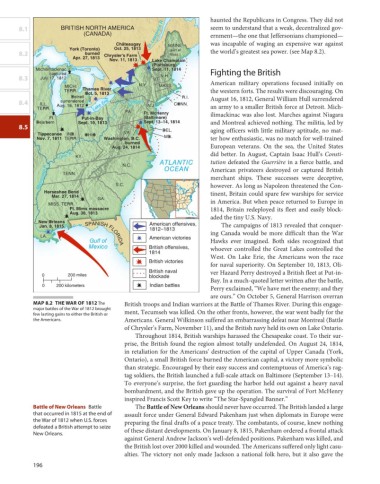
                  MAP 8.2  the WAr of 1812 The   British troops and Indian warriors at the Battle of Thames River. During this engage-
                  major battles of the War of 1812 brought
                  few lasting gains to either the British or   ment, Tecumseh was killed. On the other fronts, however, the war went badly for the
                  the Americans.                Americans. General Wilkinson suffered an embarrassing defeat near Montreal (Battle
                                                of Chrysler’s Farm, November 11), and the British navy held its own on Lake Ontario.
                                                    Throughout 1814, British warships harassed the Chesapeake coast. To their sur-
                                                prise, the British found the region almost totally undefended. On August 24, 1814,
                                                in retaliation for the Americans’ destruction of the capital of Upper Canada (York,
                                                Ontario), a small British force burned the American capital, a victory more symbolic
                                                than strategic. Encouraged by their easy success and contemptuous of America’s rag-
                                                tag soldiers, the British launched a full-scale attack on Baltimore (September 13–14).
                                                To everyone’s surprise, the fort guarding the harbor held out against a heavy naval
                                                bombardment, and the British gave up the operation. The survival of Fort McHenry
                                                inspired Francis Scott Key to write “The Star-Spangled Banner.”
                  Battle of new orleans  Battle     The Battle of New Orleans should never have occurred. The British landed a large
                  that occurred in 1815 at the end of   assault force under General Edward Pakenham just when diplomats in Europe were
                  the War of 1812 when U.S. forces   preparing the final drafts of a peace treaty. The combatants, of course, knew nothing
                  defeated a British attempt to seize
                  New Orleans.                  of these distant developments. On January 8, 1815, Pakenham ordered a frontal attack
                                                against General Andrew Jackson’s well-defended positions. Pakenham was killed, and
                                                the British lost over 2000 killed and wounded. The Americans suffered only light casu-
                                                alties. The victory not only made Jackson a national folk hero, but it also gave the
                  196

