


Page 227 - American Stories, A History of the United States
P. 227
seemed to harm Britain more than France. Faced with growing opposition, the Repub-
              8.1                               licans in Congress panicked. One representative declared that “peaceful coercion” was a
                                                “miserable and mischievous failure” and joined his colleagues in repealing the embargo
                                                a few days before James Madison’s inauguration. Relations between the United States
                     Quick Check
              8.2                               and the great European powers were worse in 1809 than they had been in 1805. During
                     Why was Jefferson’s embargo    his second term, the pressures of office weighed heavily on Jefferson. After so many
                     policy such a failure?
                                                years of public service, he welcomed retirement to Monticello.
              8.3
                                                A New Administration Goes to War

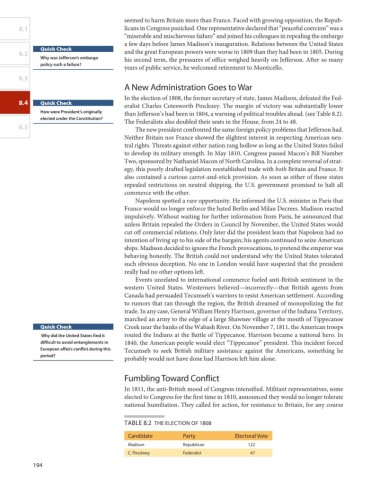
                                                In the election of 1808, the former secretary of state, James Madison, defeated the Fed-
              8.4    Quick Check                eralist Charles Cotesworth Pinckney. The margin of victory was substantially lower
                     How were President’s originally   than Jefferson’s had been in 1804, a warning of political troubles ahead. (see Table 8.2).
                     elected under the Constitution?  The Federalists also doubled their seats in the House, from 24 to 48.
              8.5                                   The new president confronted the same foreign policy problems that Jefferson had.
                                                Neither Britain nor France showed the slightest interest in respecting American neu-
                                                tral rights. Threats against either nation rang hollow as long as the United States failed
                                                to develop its military strength. In May 1810, Congress passed Macon’s Bill Number
                                                Two, sponsored by Nathaniel Macon of North Carolina. In a complete reversal of strat-
                                                egy, this poorly drafted legislation reestablished trade with both Britain and France. It
                                                also contained a curious carrot-and-stick provision. As soon as either of these states
                                                repealed restrictions on neutral shipping, the U.S. government promised to halt all
                                                commerce with the other.
                                                    Napoleon spotted a rare opportunity. He informed the U.S. minister in Paris that
                                                France would no longer enforce the hated Berlin and Milan Decrees. Madison reacted
                                                impulsively. Without waiting for further information from Paris, he announced that
                                                unless Britain repealed the Orders in Council by November, the United States would
                                                cut off commercial relations. Only later did the president learn that Napoleon had no
                                                intention of living up to his side of the bargain; his agents continued to seize American
                                                ships. Madison decided to ignore the French provocations, to pretend the emperor was
                                                behaving honestly. The British could not understand why the United States tolerated
                                                such obvious deception. No one in London would have suspected that the president
                                                really had no other options left.
                                                    Events unrelated to international commerce fueled anti-British sentiment in the
                                                western United States. Westerners believed—incorrectly—that British agents from
                                                Canada had persuaded Tecumseh’s warriors to resist American settlement. According
                                                to rumors that ran through the region, the British dreamed of monopolizing the fur
                                                trade. In any case, General William Henry Harrison, governor of the Indiana Territory,
                                                marched an army to the edge of a large Shawnee village at the mouth of  Tippecanoe
                     Quick Check                Creek near the banks of the Wabash River. On November 7, 1811, the American troops
                      Why did the United States find it   routed the Indians at the Battle of Tippecanoe. Harrison became a national hero. In
                     difficult to avoid entanglements in   1840, the American people would elect “Tippecanoe” president. This incident forced
                     European affairs conflict during this   Tecumseh to seek British military assistance against the Americans, something he
                     period?
                                                probably would not have done had Harrison left him alone.

                                                Fumbling Toward Conflict
                                                In 1811, the anti-British mood of Congress intensified. Militant representatives, some
                                                elected to Congress for the first time in 1810, announced they would no longer tolerate
                                                national humiliation. They called for action, for resistance to Britain, for any course


                                                TABLE 8.2  THE ELECTION OF 1808
                                                  Candidate         Party            Electoral vote
                                                  Madison           Republican           122
                                                  C. Pinckney       Federalist             47
                  194

