


Page 387 - Business Principles and Management
P. 387
Unit 4


                                                   When new planning procedures are used or new activities are implemented,
                                                planning is less likely to be accurate. Standards developed in those situations
                                                should be studied more carefully than the standards for ongoing activities or
                                                standards that have been developed in the same way for a long period of time.
                                                   Standards should be revised when it is clear they will not accurately reflect per-
                                                formance and attempts to improve performance have been unsuccessful. When
                                                standards are changed, the new standards and the reasons for the changes should
                                                be clearly communicated to the employees affected. Also, the procedures for set-
                                                ting standards should be revised so that standards developed in the future are
                                                more accurate.


                                                             CHECKPOINT
                                                             Why should managers be reluctant to change standards even
                                                             when performance does not meet those standards?


                                                Controlling Costs

                                                All managers need to watch constantly for ways to reduce costs. Excessive costs
                                                reduce the company’s profit. There are several areas in a business where managers
                                                can anticipate cost problems and develop ways to reduce costs. They are inven-
                                                tory, credit, theft, and employee health and safety.

                                                INVENTORY Manufacturers need to produce enough of each product to fill
                                                the orders they receive. They need enough raw materials to produce those
                                                products. Wholesalers and retailers must maintain inventories to meet their
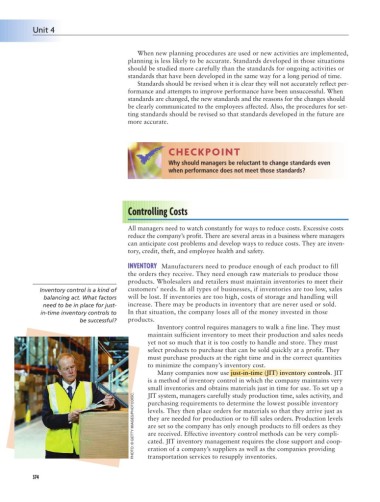
                    Inventory control is a kind of  customers’ needs. In all types of businesses, if inventories are too low, sales
                     balancing act. What factors  will be lost. If inventories are too high, costs of storage and handling will
                     need to be in place for just-  increase. There may be products in inventory that are never used or sold.
                    in-time inventory controls to  In that situation, the company loses all of the money invested in those
                                 be successful?  products.
                                                         Inventory control requires managers to walk a fine line. They must
                                                      maintain sufficient inventory to meet their production and sales needs
                                                      yet not so much that it is too costly to handle and store. They must
                                                      select products to purchase that can be sold quickly at a profit. They
                                                      must purchase products at the right time and in the correct quantities
                                                      to minimize the company’s inventory cost.
                                                         Many companies now use just-in-time (JIT) inventory controls. JIT
                                                      is a method of inventory control in which the company maintains very
                                                      small inventories and obtains materials just in time for use. To set up a
                                                  PHOTO: © GETTY IMAGES/PHOTODISC.  levels. They then place orders for materials so that they arrive just as
                                                      JIT system, managers carefully study production time, sales activity, and
                                                      purchasing requirements to determine the lowest possible inventory

                                                      they are needed for production or to fill sales orders. Production levels
                                                      are set so the company has only enough products to fill orders as they
                                                      are received. Effective inventory control methods can be very compli-
                                                      cated. JIT inventory management requires the close support and coop-
                                                      eration of a company’s suppliers as well as the companies providing


                  374                                 transportation services to resupply inventories.

