


Page 556 - Business Principles and Management
P. 556
Chapter 20 • Nature and Scope of Marketing


                        marketing locations enables a business to
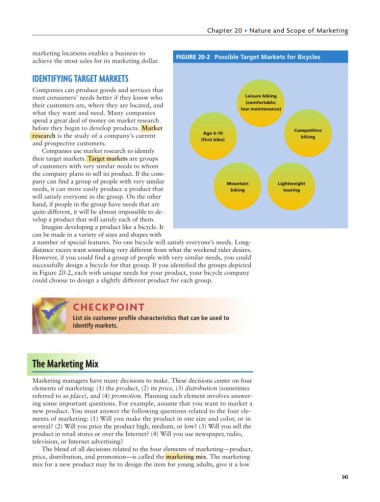
                        achieve the most sales for its marketing dollar.  FIGURE 20-2 Possible Target Markets for Bicycles


                        IDENTIFYING TARGET MARKETS
                        Companies can produce goods and services that
                        meet consumers’ needs better if they know who                      Leisure biking
                        their customers are, where they are located, and                   (comfortable;
                                                                                          low maintenance)
                        what they want and need. Many companies
                        spend a great deal of money on market research
                        before they begin to develop products. Market                                     Competitive
                        research is the study of a company’s current          Age 6-10                       biking
                        and prospective customers.                           (first bike)
                           Companies use market research to identify
                        their target markets. Target markets are groups
                        of customers with very similar needs to whom
                        the company plans to sell its product. If the com-
                        pany can find a group of people with very similar
                                                                                     Mountain        Lightweight
                        needs, it can more easily produce a product that              biking           touring
                        will satisfy everyone in the group. On the other
                        hand, if people in the group have needs that are
                        quite different, it will be almost impossible to de-
                        velop a product that will satisfy each of them.
                           Imagine developing a product like a bicycle. It
                        can be made in a variety of sizes and shapes with
                        a number of special features. No one bicycle will satisfy everyone’s needs. Long-
                        distance racers want something very different from what the weekend rider desires.
                        However, if you could find a group of people with very similar needs, you could
                        successfully design a bicycle for that group. If you identified the groups depicted
                        in Figure 20-2, each with unique needs for your product, your bicycle company
                        could choose to design a slightly different product for each group.


                                     CHECKPOINT
                                     List six customer profile characteristics that can be used to
                                     identify markets.


                        The Marketing Mix

                        Marketing managers have many decisions to make. These decisions center on four
                        elements of marketing: (1) the product, (2) its price, (3) distribution (sometimes
                        referred to as place), and (4) promotion. Planning each element involves answer-
                        ing some important questions. For example, assume that you want to market a
                        new product. You must answer the following questions related to the four ele-
                        ments of marketing: (1) Will you make the product in one size and color, or in
                        several? (2) Will you price the product high, medium, or low? (3) Will you sell the
                        product in retail stores or over the Internet? (4) Will you use newspaper, radio,
                        television, or Internet advertising?
                           The blend of all decisions related to the four elements of marketing—product,
                        price, distribution, and promotion—is called the marketing mix. The marketing
                        mix for a new product may be to design the item for young adults, give it a low

                                                                                                                          543

