


Page 662 - Business Principles and Management
P. 662
Chapter 24 • Rewarding and Developing Employees


                        HOURS OF WORK
                        To respond to the changing lifestyles of workers and the operat-
                        ing needs of businesses, some companies have experimented
                        with changes in the standard 40-hour, five-day workweek. One
                        such change involves scheduling employees to work 10 hours a
                        day for four days per week. Another variation, flex-time, lets
                        employees choose their own work hours within specified limits.
                        Job sharing allows two people to share one full-time job. Each
                        person works half the time, either half days or alternate days of
                        the week.
                           Companies may also stagger the workweek by having some
                        employees start their week on days other than Monday. In this  PHOTO: © GETTY IMAGES/PHOTODISC.
                        way, the business can operate seven days a week without having
                        employees work more than five days, thereby obtaining maximum
                        use of facilities and equipment while controlling labor costs. It is
                        also a way to reduce traffic congestion or demands on employee
                        services, such as parking and food services, at specific times.

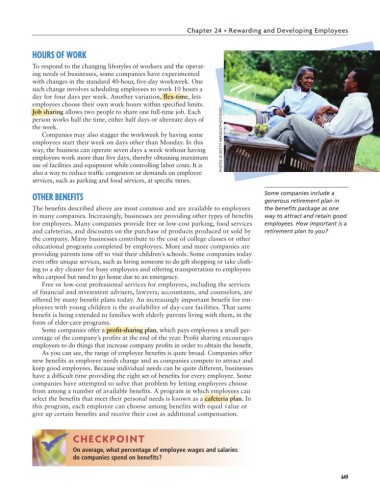
                        OTHER BENEFITS                                                           Some companies include a
                                                                                                 generous retirement plan in
                        The benefits described above are most common and are available to employees  the benefits package as one
                        in many companies. Increasingly, businesses are providing other types of benefits  way to attract and retain good
                        for employees. Many companies provide free or low-cost parking, food services  employees. How important is a
                        and cafeterias, and discounts on the purchase of products produced or sold by  retirement plan to you?
                        the company. Many businesses contribute to the cost of college classes or other
                        educational programs completed by employees. More and more companies are
                        providing parents time off to visit their children’s schools. Some companies today
                        even offer unique services, such as hiring someone to do gift shopping or take cloth-
                        ing to a dry cleaner for busy employees and offering transportation to employees
                        who carpool but need to go home due to an emergency.
                           Free or low-cost professional services for employees, including the services
                        of financial and investment advisers, lawyers, accountants, and counselors, are
                        offered by many benefit plans today. An increasingly important benefit for em-
                        ployees with young children is the availability of day-care facilities. That same
                        benefit is being extended to families with elderly parents living with them, in the
                        form of elder-care programs.
                           Some companies offer a profit-sharing plan, which pays employees a small per-
                        centage of the company’s profits at the end of the year. Profit sharing encourages
                        employees to do things that increase company profits in order to obtain the benefit.
                           As you can see, the range of employee benefits is quite broad. Companies offer
                        new benefits as employee needs change and as companies compete to attract and
                        keep good employees. Because individual needs can be quite different, businesses
                        have a difficult time providing the right set of benefits for every employee. Some
                        companies have attempted to solve that problem by letting employees choose
                        from among a number of available benefits. A program in which employees can
                        select the benefits that meet their personal needs is known as a cafeteria plan. In
                        this program, each employee can choose among benefits with equal value or
                        give up certain benefits and receive their cost as additional compensation.


                                     CHECKPOINT
                                     On average, what percentage of employee wages and salaries
                                     do companies spend on benefits?


                                                                                                                         649

