


Page 657 - Business Principles and Management
P. 657
Unit 7


                                                       for greater experience or more years worked for the company. The sup-
                                                       ply and demand for that type of labor, current economic conditions, and
                                                       the prevailing wage rates in the community and the industry also affect
                                                       the rate of pay. Companies may choose to provide a range of employee
                                                       benefits as an alternative to high wages. Finally, federal and state labor
                                                       laws, such as laws that set minimum wages, affect employee pay.


                                                       THE IMPORTANCE OF COMPENSATION PLANNING
                                                       Human resources departments are usually charged with developing and
                                                  PHOTO: © GETTY IMAGES/PHOTODISC.  is often one of the largest expenses of a company, it is important that the
                                                       maintaining a company’s compensation system. Because compensation

                                                       total compensation paid is consistent with the sales and other income
                                                       earned by the business. If compensation costs are too high, the company
                                                       will be unable to earn a profit. On the other hand, if wages and salaries
                                                       are too low, the company will be unable to attract the number of employ-
                                                       ees needed with the skills required to perform the company’s work. In
                                                       either case, the company will be at a competitive disadvantage.
                                                          Usually human resources departments of large companies employ econ-
                                                       omists and other specialists to develop pay plans and to help determine the
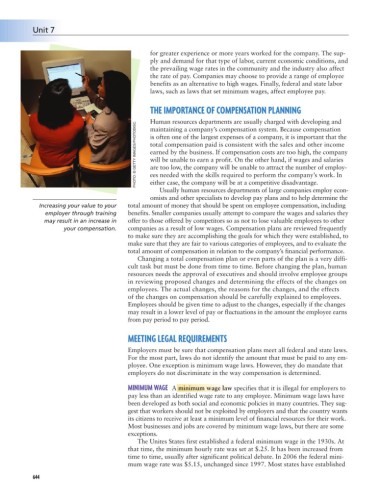
                    Increasing your value to your  total amount of money that should be spent on employee compensation, including
                      employer through training  benefits. Smaller companies usually attempt to compare the wages and salaries they
                     may result in an increase in  offer to those offered by competitors so as not to lose valuable employees to other
                            your compensation.  companies as a result of low wages. Compensation plans are reviewed frequently
                                                to make sure they are accomplishing the goals for which they were established, to
                                                make sure that they are fair to various categories of employees, and to evaluate the
                                                total amount of compensation in relation to the company’s financial performance.
                                                   Changing a total compensation plan or even parts of the plan is a very diffi-
                                                cult task but must be done from time to time. Before changing the plan, human
                                                resources needs the approval of executives and should involve employee groups
                                                in reviewing proposed changes and determining the effects of the changes on
                                                employees. The actual changes, the reasons for the changes, and the effects
                                                of the changes on compensation should be carefully explained to employees.
                                                Employees should be given time to adjust to the changes, especially if the changes
                                                may result in a lower level of pay or fluctuations in the amount the employee earns
                                                from pay period to pay period.


                                                MEETING LEGAL REQUIREMENTS
                                                Employers must be sure that compensation plans meet all federal and state laws.
                                                For the most part, laws do not identify the amount that must be paid to any em-
                                                ployee. One exception is minimum wage laws. However, they do mandate that
                                                employers do not discriminate in the way compensation is determined.

                                                MINIMUM WAGE A minimum wage law specifies that it is illegal for employers to
                                                pay less than an identified wage rate to any employee. Minimum wage laws have
                                                been developed as both social and economic policies in many countries. They sug-
                                                gest that workers should not be exploited by employers and that the country wants
                                                its citizens to receive at least a minimum level of financial resources for their work.
                                                Most businesses and jobs are covered by minimum wage laws, but there are some
                                                exceptions.
                                                   The Unites States first established a federal minimum wage in the 1930s. At
                                                that time, the minimum hourly rate was set at $.25. It has been increased from
                                                time to time, usually after significant political debate. In 2006 the federal mini-
                                                mum wage rate was $5.15, unchanged since 1997. Most states have established

                  644

