


Page 658 - Business Principles and Management
P. 658
Chapter 24 • Rewarding and Developing Employees


                        minimum wage rates that apply to most businesses within those states. Only six
                        states do not have their own minimum wage. As with all states, the federal mini-
                        mum wage law still applies. Many states set their minimum wage rate at the same
                        level as the federal rate. However, in recent years, more and more states have estab-
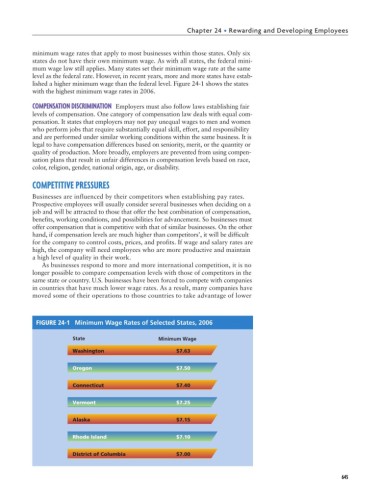
                        lished a higher minimum wage than the federal level. Figure 24-1 shows the states
                        with the highest minimum wage rates in 2006.

                        COMPENSATION DISCRIMINATION Employers must also follow laws establishing fair
                        levels of compensation. One category of compensation law deals with equal com-
                        pensation. It states that employers may not pay unequal wages to men and women
                        who perform jobs that require substantially equal skill, effort, and responsibility
                        and are performed under similar working conditions within the same business. It is
                        legal to have compensation differences based on seniority, merit, or the quantity or
                        quality of production. More broadly, employers are prevented from using compen-
                        sation plans that result in unfair differences in compensation levels based on race,
                        color, religion, gender, national origin, age, or disability.


                        COMPETITIVE PRESSURES
                        Businesses are influenced by their competitors when establishing pay rates.
                        Prospective employees will usually consider several businesses when deciding on a
                        job and will be attracted to those that offer the best combination of compensation,
                        benefits, working conditions, and possibilities for advancement. So businesses must
                        offer compensation that is competitive with that of similar businesses. On the other
                        hand, if compensation levels are much higher than competitors’, it will be difficult
                        for the company to control costs, prices, and profits. If wage and salary rates are
                        high, the company will need employees who are more productive and maintain
                        a high level of quality in their work.
                           As businesses respond to more and more international competition, it is no
                        longer possible to compare compensation levels with those of competitors in the
                        same state or country. U.S. businesses have been forced to compete with companies
                        in countries that have much lower wage rates. As a result, many companies have
                        moved some of their operations to those countries to take advantage of lower


                         FIGURE 24-1 Minimum Wage Rates of Selected States, 2006

                                     State                      Minimum Wage

                                     Washington                      $7.63

                                     Oregon                          $7.50

                                     Connecticut                     $7.40


                                     Vermont                         $7.25

                                     Alaska                          $7.15


                                     Rhode Island                    $7.10

                                     District of Columbia            $7.00


                                                                                                                         645

