


Page 560 - Basic Electrical Engineering
P. 560
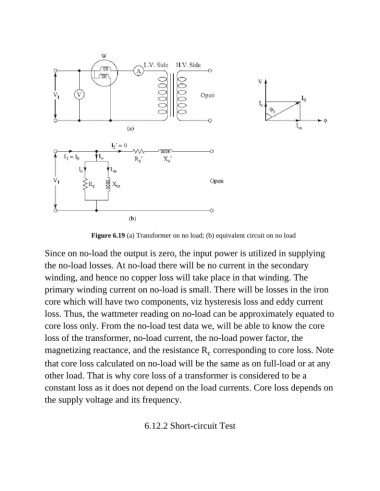
Figure 6.19 (a) Transformer on no load; (b) equivalent circuit on no load

               Since on no-load the output is zero, the input power is utilized in supplying

               the no-load losses. At no-load there will be no current in the secondary
               winding, and hence no copper loss will take place in that winding. The

               primary winding current on no-load is small. There will be losses in the iron
               core which will have two components, viz hysteresis loss and eddy current
               loss. Thus, the wattmeter reading on no-load can be approximately equated to

               core loss only. From the no-load test data we, will be able to know the core
               loss of the transformer, no-load current, the no-load power factor, the

               magnetizing reactance, and the resistance R  corresponding to core loss. Note
                                                                    c
               that core loss calculated on no-load will be the same as on full-load or at any
               other load. That is why core loss of a transformer is considered to be a

               constant loss as it does not depend on the load currents. Core loss depends on
               the supply voltage and its frequency.


                                                6.12.2 Short-circuit Test

