


Page 558 - Basic Electrical Engineering
P. 558
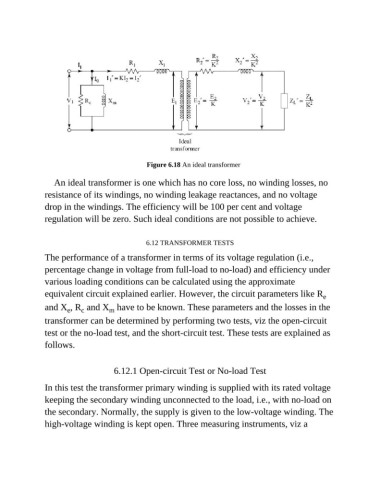
Figure 6.18 An ideal transformer

                  An ideal transformer is one which has no core loss, no winding losses, no
               resistance of its windings, no winding leakage reactances, and no voltage

               drop in the windings. The efficiency will be 100 per cent and voltage
               regulation will be zero. Such ideal conditions are not possible to achieve.


                                                6.12 TRANSFORMER TESTS

               The performance of a transformer in terms of its voltage regulation (i.e.,

               percentage change in voltage from full-load to no-load) and efficiency under
               various loading conditions can be calculated using the approximate
               equivalent circuit explained earlier. However, the circuit parameters like R              e

               and X , R  and X  have to be known. These parameters and the losses in the
                           c
                       e
                                    m
               transformer can be determined by performing two tests, viz the open-circuit
               test or the no-load test, and the short-circuit test. These tests are explained as

               follows.


                                      6.12.1 Open-circuit Test or No-load Test


               In this test the transformer primary winding is supplied with its rated voltage
               keeping the secondary winding unconnected to the load, i.e., with no-load on
               the secondary. Normally, the supply is given to the low-voltage winding. The

               high-voltage winding is kept open. Three measuring instruments, viz a

