


Page 557 - Basic Electrical Engineering
P. 557
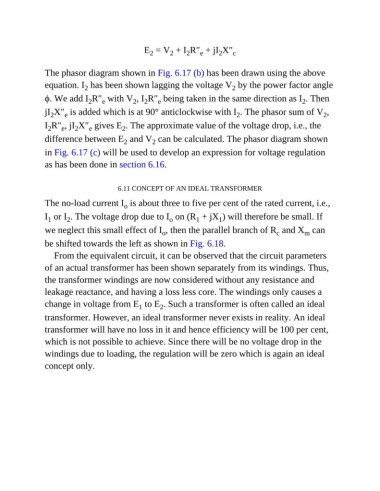
E  = V  + I R″  + jI X″      c
                                                             2
                                                        2
                                                 2
                                                                 e
                                                                       2
               The phasor diagram shown in Fig. 6.17 (b) has been drawn using the above
               equation. I  has been shown lagging the voltage V  by the power factor angle
                            2
                                                                            2
               ϕ. We add I R″  with V , I R″  being taken in the same direction as I . Then
                                               2
                                                    e
                             2
                                  e
                                            2
                                                                                                  2
               jI X″  is added which is at 90° anticlockwise with I . The phasor sum of V ,
                 2
                                                                                                         2
                                                                             2
                      e
               I R″ , jI X″  gives E . The approximate value of the voltage drop, i.e., the
                         2
                                        2
                              e
                2
                     e
               difference between E  and V  can be calculated. The phasor diagram shown
                                         2
                                                  2
               in Fig. 6.17 (c) will be used to develop an expression for voltage regulation
               as has been done in section 6.16.
                                       6.11 CONCEPT OF AN IDEAL TRANSFORMER
               The no-load current I  is about three to five per cent of the rated current, i.e.,
                                         o
               I  or I . The voltage drop due to I  on (R  + jX ) will therefore be small. If
                1
                       2
                                                        o
                                                                       1
                                                                1
               we neglect this small effect of I , then the parallel branch of R  and X  can
                                                     o
                                                                                          c
                                                                                                   m
               be shifted towards the left as shown in Fig. 6.18.
                  From the equivalent circuit, it can be observed that the circuit parameters
               of an actual transformer has been shown separately from its windings. Thus,
               the transformer windings are now considered without any resistance and
               leakage reactance, and having a loss less core. The windings only causes a
               change in voltage from E  to E . Such a transformer is often called an ideal
                                              1
                                                    2
               transformer. However, an ideal transformer never exists in reality. An ideal
               transformer will have no loss in it and hence efficiency will be 100 per cent,
               which is not possible to achieve. Since there will be no voltage drop in the

               windings due to loading, the regulation will be zero which is again an ideal
               concept only.

