


Page 552 - Basic Electrical Engineering
P. 552
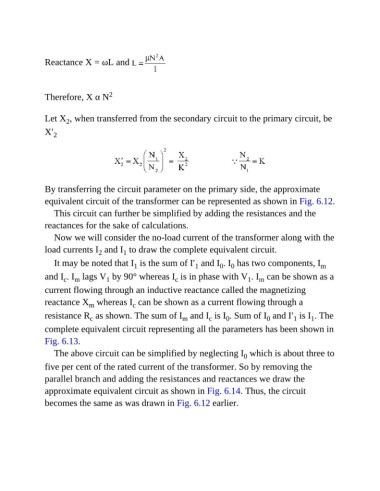
Reactance X = ωL and


               Therefore, X α N     2


               Let X , when transferred from the secondary circuit to the primary circuit, be
                      2
               X′ 2


               By transferring the circuit parameter on the primary side, the approximate

               equivalent circuit of the transformer can be represented as shown in Fig. 6.12.
                  This circuit can further be simplified by adding the resistances and the

               reactances for the sake of calculations.
                  Now we will consider the no-load current of the transformer along with the

               load currents I  and I  to draw the complete equivalent circuit.
                                         1
                                 2
                  It may be noted that I  is the sum of I′  and I . I  has two components, I            m
                                            1
                                                                        0
                                                                           0
                                                                1
               and I . I  lags V  by 90° whereas I  is in phase with V . I  can be shown as a
                                                                                    m
                         m
                                   1
                                                         c
                                                                                 1
                     c
               current flowing through an inductive reactance called the magnetizing
               reactance X  whereas I  can be shown as a current flowing through a
                                            c
                              m
               resistance R  as shown. The sum of I  and I  is I . Sum of I  and I′  is I . The
                                                            m
                                                                          0
                                                                    c
                                                                                                     1
                                                                                       0
                                                                                                1
                              c
               complete equivalent circuit representing all the parameters has been shown in
               Fig. 6.13.
                  The above circuit can be simplified by neglecting I  which is about three to
                                                                                0
               five per cent of the rated current of the transformer. So by removing the
               parallel branch and adding the resistances and reactances we draw the
               approximate equivalent circuit as shown in Fig. 6.14. Thus, the circuit
               becomes the same as was drawn in Fig. 6.12 earlier.

