


Page 742 - Basic Electrical Engineering
P. 742
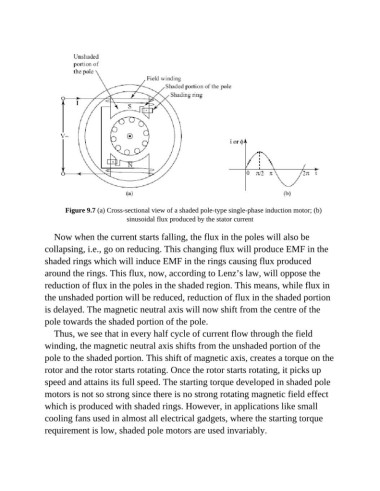
Figure 9.7 (a) Cross-sectional view of a shaded pole-type single-phase induction motor; (b)
                                          sinusoidal flux produced by the stator current

                  Now when the current starts falling, the flux in the poles will also be

               collapsing, i.e., go on reducing. This changing flux will produce EMF in the
               shaded rings which will induce EMF in the rings causing flux produced
               around the rings. This flux, now, according to Lenz’s law, will oppose the

               reduction of flux in the poles in the shaded region. This means, while flux in
               the unshaded portion will be reduced, reduction of flux in the shaded portion

               is delayed. The magnetic neutral axis will now shift from the centre of the
               pole towards the shaded portion of the pole.

                  Thus, we see that in every half cycle of current flow through the field
               winding, the magnetic neutral axis shifts from the unshaded portion of the

               pole to the shaded portion. This shift of magnetic axis, creates a torque on the
               rotor and the rotor starts rotating. Once the rotor starts rotating, it picks up
               speed and attains its full speed. The starting torque developed in shaded pole

               motors is not so strong since there is no strong rotating magnetic field effect
               which is produced with shaded rings. However, in applications like small

               cooling fans used in almost all electrical gadgets, where the starting torque
               requirement is low, shaded pole motors are used invariably.

