


Page 746 - Basic Electrical Engineering
P. 746
Reluctance motors are single-phase motors where the stator construction is
               similar to that of an induction motor. That is, the stator has one main winding
               and one auxiliary winding. Both the windings are connected in parallel. The

               rotor construction is somewhat different than a single-phase induction motor.
               Some of the tooths of the rotor are removed so as to make the air gap

               between the stator and rotor non-uniform. This way the reluctance of the
               motor across the air gap becomes variable. The squirrel cage bars and the end

               rings of the rotor remain the same.
                  When single-phase supply is applied across the stator winding, the rotor

               starts rotating as an induction motor. At about 70% of the synchronous speed,
               the starting winding is cut off automatically. However, the rotor continues to
               speed up and attain synchronous speed due to reluctance torque developed.

               The rotor aligns itself with the synchronously rotating field and runs at
               synchronous speed.

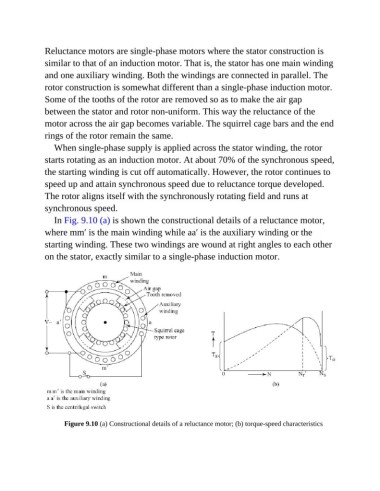
                  In Fig. 9.10 (a) is shown the constructional details of a reluctance motor,
               where mm′ is the main winding while aa′ is the auxiliary winding or the

               starting winding. These two windings are wound at right angles to each other
               on the stator, exactly similar to a single-phase induction motor.


                      Figure 9.10 (a) Constructional details of a reluctance motor; (b) torque-speed characteristics

