


Page 748 - Basic Electrical Engineering
P. 748
synchronous speed as shown in Fig. 9.11 (b). The performance of a single-
               phase hysteresis motor is silent (no noise) because there is no slot on the rotor
               and the rotor surface is smooth.


                                                  9.10 STEPPER MOTORS
               Stepper motors are also called the step motors. They rotate in steps by a

               certain angle depending upon the design. The rotor of such motors may be
               made of a set of permanent magnets or with a soft magnetic material with

               salient poles. The stator will have a set of poles with winding as shown in
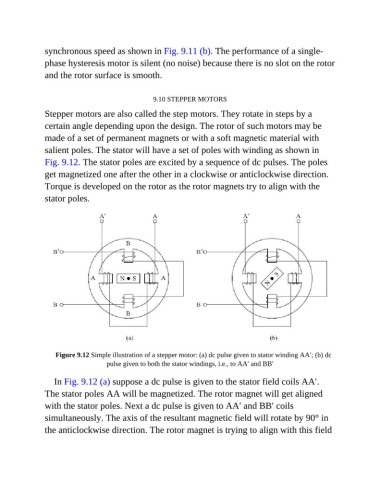
               Fig. 9.12. The stator poles are excited by a sequence of dc pulses. The poles
               get magnetized one after the other in a clockwise or anticlockwise direction.

               Torque is developed on the rotor as the rotor magnets try to align with the
               stator poles.


                   Figure 9.12 Simple illustration of a stepper motor: (a) dc pulse given to stator winding AA′; (b) dc
                                   pulse given to both the stator windings, i.e., to AA′ and BB′

                  In Fig. 9.12 (a) suppose a dc pulse is given to the stator field coils AA′.

               The stator poles AA will be magnetized. The rotor magnet will get aligned
               with the stator poles. Next a dc pulse is given to AA′ and BB′ coils

               simultaneously. The axis of the resultant magnetic field will rotate by 90° in
               the anticlockwise direction. The rotor magnet is trying to align with this field

