


Page 743 - Basic Electrical Engineering
P. 743
9.7 SINGLE-PHASE AC SERIES MOTORS

               We have known that in a dc series motor if we change the supply polarities of
               either the field winding or the armature winding, the direction of rotation

               changes. If we reverse the polarities of both the field winding and the
               armature winding to the power supply, the direction of rotation of a dc series

               motor remains unchanged. From this, it can be said that a dc series motor
               should also work on ac supply as well. A series motor which will work on

               both dc supply and single-phase ac supply is called an universal motor.
               Universal motors in fractional kilowatt ratings are used in many domestic

               electrical appliances like food mixtures, vacuum cleaners, portable drills, etc.
               These small motors are usually light in weight and operate at very high
               speeds varying from 1,500 rpm to 10,000 rpm.

                  It can be noticed from Fig. 9.8 that in a series motor, the line current, the
               field current, and the armature current is the same. The current flowing

               through the field windings produces a flux ϕ  along the pole axis, i.e., the
                                                                     d
               direct axis or simply the d-axis. The current flowing through the armature I               a

               will also produce a flux ϕ  in the quadrature axis (Q-axis), i.e., along the
                                              q
               brush axis.
                  The torque developed is expressed as


                                                T = K ϕ I                  (i)
                                                       t d a


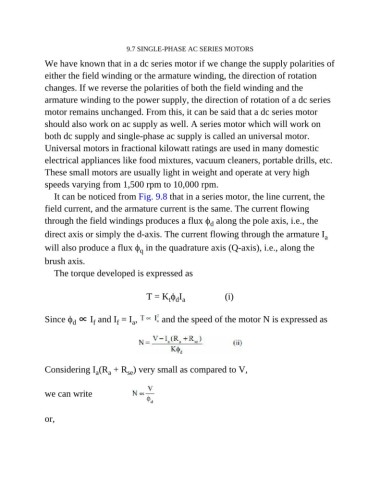
               Since ϕ  ∝ I  and I  = I ,            and the speed of the motor N is expressed as
                                       f
                                            a
                               f
                        d


               Considering I (R  + R ) very small as compared to V,
                                a
                                          se
                                    a
               we can write


               or,

