


Page 747 - Basic Electrical Engineering
P. 747
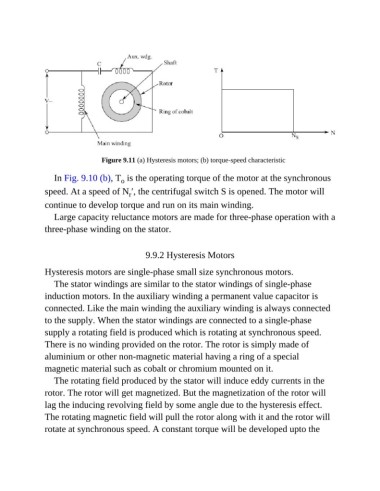
Figure 9.11 (a) Hysteresis motors; (b) torque-speed characteristic

                  In Fig. 9.10 (b), T  is the operating torque of the motor at the synchronous
                                        o
               speed. At a speed of N ′, the centrifugal switch S is opened. The motor will
                                           r
               continue to develop torque and run on its main winding.
                  Large capacity reluctance motors are made for three-phase operation with a

               three-phase winding on the stator.


                                                9.9.2 Hysteresis Motors

               Hysteresis motors are single-phase small size synchronous motors.
                  The stator windings are similar to the stator windings of single-phase

               induction motors. In the auxiliary winding a permanent value capacitor is
               connected. Like the main winding the auxiliary winding is always connected

               to the supply. When the stator windings are connected to a single-phase
               supply a rotating field is produced which is rotating at synchronous speed.

               There is no winding provided on the rotor. The rotor is simply made of
               aluminium or other non-magnetic material having a ring of a special

               magnetic material such as cobalt or chromium mounted on it.
                  The rotating field produced by the stator will induce eddy currents in the
               rotor. The rotor will get magnetized. But the magnetization of the rotor will

               lag the inducing revolving field by some angle due to the hysteresis effect.
               The rotating magnetic field will pull the rotor along with it and the rotor will

               rotate at synchronous speed. A constant torque will be developed upto the

