


Page 745 - Basic Electrical Engineering
P. 745
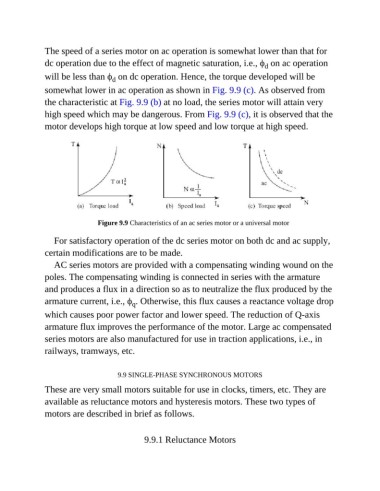
The speed of a series motor on ac operation is somewhat lower than that for
               dc operation due to the effect of magnetic saturation, i.e., ϕ  on ac operation
                                                                                      d
               will be less than ϕ  on dc operation. Hence, the torque developed will be
                                     d
               somewhat lower in ac operation as shown in Fig. 9.9 (c). As observed from
               the characteristic at Fig. 9.9 (b) at no load, the series motor will attain very
               high speed which may be dangerous. From Fig. 9.9 (c), it is observed that the

               motor develops high torque at low speed and low torque at high speed.


                                Figure 9.9 Characteristics of an ac series motor or a universal motor


                  For satisfactory operation of the dc series motor on both dc and ac supply,
               certain modifications are to be made.

                  AC series motors are provided with a compensating winding wound on the
               poles. The compensating winding is connected in series with the armature

               and produces a flux in a direction so as to neutralize the flux produced by the
               armature current, i.e., ϕ . Otherwise, this flux causes a reactance voltage drop
                                            q
               which causes poor power factor and lower speed. The reduction of Q-axis
               armature flux improves the performance of the motor. Large ac compensated

               series motors are also manufactured for use in traction applications, i.e., in
               railways, tramways, etc.


                                       9.9 SINGLE-PHASE SYNCHRONOUS MOTORS

               These are very small motors suitable for use in clocks, timers, etc. They are
               available as reluctance motors and hysteresis motors. These two types of

               motors are described in brief as follows.


                                               9.9.1 Reluctance Motors

