


Page 765 - Basic Electrical Engineering
P. 765
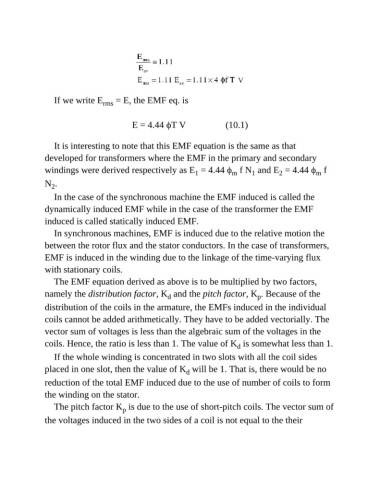
If we write E   rms  = E, the EMF eq. is

                                            E = 4.44 ϕT V                 (10.1)


                  It is interesting to note that this EMF equation is the same as that
               developed for transformers where the EMF in the primary and secondary

               windings were derived respectively as E  = 4.44 ϕ  f N  and E  = 4.44 ϕ  f
                                                                            m
                                                                1
                                                                                                       m
                                                                                           2
                                                                                  1
               N .
                  2
                  In the case of the synchronous machine the EMF induced is called the
               dynamically induced EMF while in the case of the transformer the EMF
               induced is called statically induced EMF.
                  In synchronous machines, EMF is induced due to the relative motion the

               between the rotor flux and the stator conductors. In the case of transformers,
               EMF is induced in the winding due to the linkage of the time-varying flux

               with stationary coils.
                  The EMF equation derived as above is to be multiplied by two factors,
               namely the distribution factor, K  and the pitch factor, K . Because of the
                                                                                    p
                                                       d
               distribution of the coils in the armature, the EMFs induced in the individual

               coils cannot be added arithmetically. They have to be added vectorially. The
               vector sum of voltages is less than the algebraic sum of the voltages in the
               coils. Hence, the ratio is less than 1. The value of K  is somewhat less than 1.
                                                                             d
                  If the whole winding is concentrated in two slots with all the coil sides

               placed in one slot, then the value of K  will be 1. That is, there would be no
                                                             d
               reduction of the total EMF induced due to the use of number of coils to form

               the winding on the stator.
                  The pitch factor K  is due to the use of short-pitch coils. The vector sum of
                                        p
               the voltages induced in the two sides of a coil is not equal to the their

