


Page 774 - Basic Electrical Engineering
P. 774
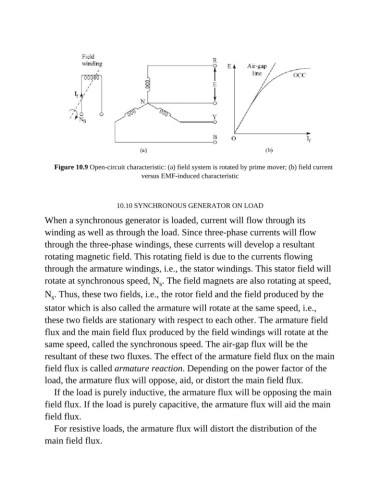
Figure 10.9 Open-circuit characteristic: (a) field system is rotated by prime mover; (b) field current
                                               versus EMF-induced characteristic


                                       10.10 SYNCHRONOUS GENERATOR ON LOAD

               When a synchronous generator is loaded, current will flow through its
               winding as well as through the load. Since three-phase currents will flow

               through the three-phase windings, these currents will develop a resultant
               rotating magnetic field. This rotating field is due to the currents flowing

               through the armature windings, i.e., the stator windings. This stator field will
               rotate at synchronous speed, N . The field magnets are also rotating at speed,
                                                    s
               N . Thus, these two fields, i.e., the rotor field and the field produced by the
                  s
               stator which is also called the armature will rotate at the same speed, i.e.,

               these two fields are stationary with respect to each other. The armature field
               flux and the main field flux produced by the field windings will rotate at the

               same speed, called the synchronous speed. The air-gap flux will be the
               resultant of these two fluxes. The effect of the armature field flux on the main

               field flux is called armature reaction. Depending on the power factor of the
               load, the armature flux will oppose, aid, or distort the main field flux.
                  If the load is purely inductive, the armature flux will be opposing the main

               field flux. If the load is purely capacitive, the armature flux will aid the main
               field flux.

                  For resistive loads, the armature flux will distort the distribution of the
               main field flux.

