


Page 128 - Computer Graphics Handout
P. 128
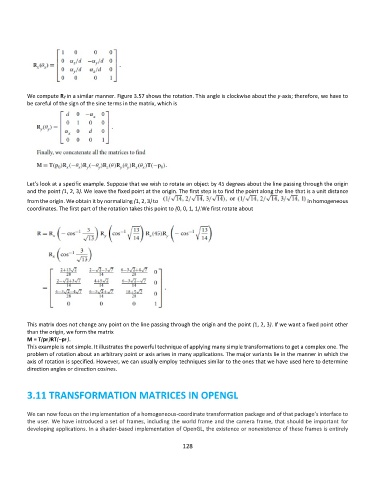
We compute Ry in a similar manner. Figure 3.57 shows the rotation. This angle is clockwise about the y-axis; therefore, we have to
          be careful of the sign of the sine terms in the matrix, which is


          Let’s look at a specific example. Suppose that we wish to rotate an object by 45 degrees about the line passing through the origin
          and the point (1, 2, 3). We leave the fixed point at the origin. The first step is to find the point along the line that is a unit distance
          from the origin. We obtain it by normalizing (1, 2, 3) to                                    in homogeneous
          coordinates. The first part of the rotation takes this point to (0, 0, 1, 1).We first rotate about


          This matrix does not change any point on the line passing through the origin and the point (1, 2, 3). If we want a fixed point other
          than the origin, we form the matrix
          M = T(pf )RT(−pf ).
          This example is not simple. It illustrates the powerful technique of applying many simple transformations to get a complex one. The
          problem of rotation about an arbitrary point or axis arises in many applications. The major variants lie in the manner in which the
          axis of rotation is specified. However, we can usually employ techniques similar to the ones that we have used here to determine
          direction angles or direction cosines.


          3.11 TRANSFORMATION MATRICES IN OPENGL


          We can now focus on the implementation of a homogeneous-coordinate transformation package and of that package’s interface to
          the user. We have introduced a set of frames, including the world frame and the camera frame, that should be important for
          developing applications. In a shader-based implementation of OpenGL, the existence or nonexistence of these frames is entirely

                                                             128

