


Page 173 - Computer Graphics Handout
P. 173
which is a simple perspective-projection matrix, and the projection of the arbitrary
          point p is


          After we do the perspective division, we obtain the desired values for xp and yp:


          We have shown that we can apply a transformation N to points, and after an orthogonal projection, we obtain the same result as
          we would have for a perspective projection. This process is similar to how we converted oblique projections to orthogonal
          projections by first shearing the objects.
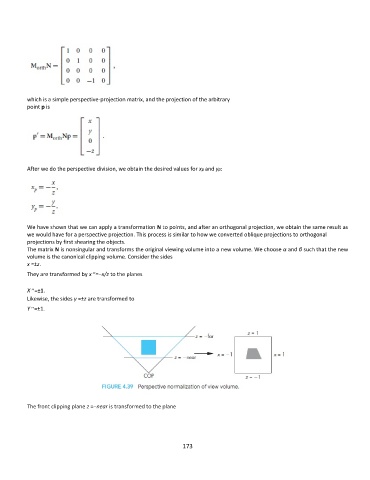
          The matrix N is nonsingular and transforms the original viewing volume into a new volume. We choose α and β such that the new
          volume is the canonical clipping volume. Consider the sides
          x =±z.
                                ,,
          They are transformed by x  =−x/z to the planes

           ,,
          X  =±1.
          Likewise, the sides y =±z are transformed to
           ,,
          Y  =±1.


          The front clipping plane z =−near is transformed to the plane


                                                             173

